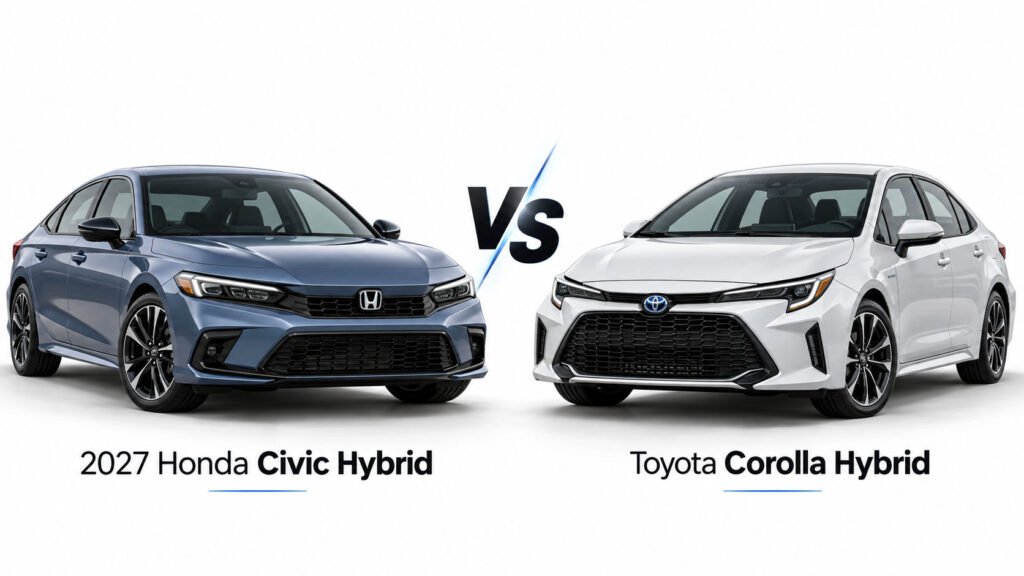
The 2027 Honda Civic Hybrid costs $4,520 more than the Toyota Corolla Hybrid, yet both promise excellent fuel economy in a practical compact sedan. The difference is what each manufacturer prioritizes. Honda gives buyers 200 horsepower, a roomier cabin and a stronger emphasis on performance. Toyota offers 138 horsepower, slightly higher published combined fuel economy and something the Civic cannot provide: optional all-wheel drive.
Neither approach is necessarily better. The real question is whether the Civic’s extra performance and space justify spending thousands more, particularly when the Corolla offers plenty of equipment for less money.
2027 Prices: What Does the Civic’s $4,520 Premium Buy?
The 2027 Toyota Corolla Hybrid LE starts at $25,175, while the Honda Civic Sport Hybrid sedan begins at $29,695. These are U.S. manufacturer-suggested retail prices, excluding the $1,295 destination charge for either model, taxes and additional dealer costs.
Toyota’s Hybrid SE starts at $27,615, and the more luxurious Hybrid XLE costs $29,540. Interestingly, that places the well-equipped Corolla XLE just $155 below Honda’s entry-level Sport Hybrid.
Buyers wanting additional traction can choose the Corolla Hybrid LE AWD for $26,575 or the SE AWD for $29,015. Honda does not offer an AWD Civic Hybrid.
For 2027, Honda introduces S+ Shift on the $32,695 Sport Touring Hybrid, simulating gear changes for a more engaging experience. The newly introduced Civic Sport-L is gasoline-powered, not a hybrid.
Toyota’s major addition is a limited-production Corolla Hybrid 60th Anniversary Special Edition, based on the SE Hybrid. Only 2,500 are planned for the U.S., with unique styling and anniversary details.
Value advantage: Toyota Corolla Hybrid. Its lower entry price creates a substantial financial advantage before fuel or maintenance costs enter the equation.
Performance: 200 HP vs 138 HP
The Civic Hybrid has the obvious advantage in power. Its 2.0-liter four-cylinder engine works with Honda’s two-motor hybrid system to deliver 200 combined horsepower.
Rather than using a conventional belt-driven CVT, Honda employs an electronically controlled direct-drive hybrid arrangement. Electric propulsion plays an important role in acceleration, while the gasoline engine can drive the wheels directly under suitable conditions.
The Corolla Hybrid uses Toyota’s fifth-generation hybrid system, combining a 1.8-liter four-cylinder engine, electric motors and an electronically controlled continuously variable transmission. Total system output is 138 horsepower.
That leaves the Honda with a 62-horsepower advantage.
For drivers frequently joining fast-moving highways, overtaking slower traffic or carrying several passengers, the Civic’s additional power offers a meaningful advantage. The Corolla’s lower output is better suited to drivers who prioritize economical, predictable transportation over brisk acceleration.
Comparable independent 2027 acceleration tests are not yet established, so assigning exact 0–60 mph times would be premature.
Performance advantage: Honda Civic Hybrid. The stronger powertrain is its clearest mechanical selling point.
Fuel Economy: Is One MPG Really Worth Considering?
Despite the horsepower difference, the published fuel-economy figures are remarkably close.
The 2027 Civic Hybrid earns EPA ratings of 50 MPG city, 47 highway and 49 combined.
Toyota estimates 53 MPG city, 46 highway and 50 combined for the Corolla Hybrid LE FWD and XLE.
These figures suggest a small advantage for Toyota in combined driving, although Honda’s numbers are EPA ratings and Toyota’s are manufacturer estimates.
Choosing different Corolla trims also changes the equation. The Hybrid SE FWD is estimated at 47 combined MPG, while the LE AWD returns an estimated 48 MPG and the SE AWD drops to 44 MPG.
The Civic Hybrid therefore compares favorably with several Corolla configurations despite its much higher horsepower.
Both vehicles are conventional, self-charging hybrids. Neither needs to be plugged into an electrical outlet, and both use regular unleaded gasoline.
For most buyers, the small published efficiency gap between the Civic and Corolla LE will matter considerably less than the purchase-price difference.
Interior Space: Why the Civic Is Better for Passengers
The Civic’s biggest everyday advantage may be its cabin rather than its engine.
Honda provides 37.4 inches of rear legroom, compared with 34.8 inches in the Corolla. That 2.6-inch difference is significant in a compact sedan, especially for taller passengers sitting behind adults.
Trunk capacity tells a similar story. The Civic sedan offers 14.8 cubic feet, while the Corolla provides 13.1 cubic feet.
Both seat five people, but the Civic offers more room for passengers and luggage. Its 60/40 split-folding rear seat also improves flexibility when transporting longer items.
Families installing rear-facing child seats may particularly appreciate the additional cabin length, although actual child-seat compatibility depends on the seat design and front-seat positioning.
The Corolla is still practical for everyday commuting, shopping and smaller households. Its slightly shorter body can also be convenient in tight parking spaces.
However, buyers regularly carrying adult rear passengers should inspect the Civic first.
Space advantage: Honda Civic Hybrid. Its roomier interior makes the higher price easier to justify for drivers who regularly use the back seats.
AWD, Technology and Comfort: The Unexpected Differences
Toyota offers one major feature Honda cannot match in this comparison: all-wheel drive.
The Corolla Hybrid’s available electronic AWD system uses an additional electric motor to assist the rear wheels when traction is needed. It can be useful in rain, snow and slippery conditions, although appropriate tires remain essential.
Technology presents a more complicated picture.
The Corolla Hybrid LE includes an 8-inch touchscreen with wireless Apple CarPlay and Android Auto compatibility. A larger 10.5-inch display is available on higher configurations.
The Civic Sport Hybrid uses a 7-inch touchscreen and requires a wired connection for smartphone integration. Moving to the Sport Touring Hybrid adds a 9-inch display, wireless smartphone integration, Google built-in functionality and a 12-speaker Bose audio system.
Honda includes heated front seats, dual-zone automatic climate control and a moonroof on the Sport Hybrid. Toyota reserves features such as heated SofTex-trimmed seating and a moonroof for its Hybrid XLE.
For 2027, Honda’s Sport Touring also gains S+ Shift, allowing drivers to experience simulated gear changes without a conventional stepped transmission.
Toyota offers more convenient smartphone connectivity at the entry level, while Honda combines additional comfort equipment with stronger performance.
Safety, Reliability and Ownership Costs
Both manufacturers provide comprehensive driver-assistance technology.
Honda Sensing includes automatic emergency braking, adaptive cruise control, lane-keeping assistance and traffic-jam assistance. Blind-spot monitoring and rear cross-traffic monitoring are included on Civic Hybrid trims.
Toyota Safety Sense 3.0 provides pre-collision assistance, adaptive cruise control, lane tracing, road-sign assistance and automatic high beams. Blind-spot monitoring with rear cross-traffic alert is standard on the 2027 Corolla lineup.
Neither vehicle should automatically receive a superior safety judgment based solely on equipment lists. Model-year-specific crash-test results and trim details must also be considered.
Toyota advertises a 10-year/150,000-mile hybrid battery warranty, whichever comes first. Its basic vehicle coverage is three years or 36,000 miles, with five-year/60,000-mile powertrain coverage.
ToyotaCare includes one year or 10,000 miles of scheduled maintenance coverage on the 2027 Corolla. Honda lists a one-year/12,000-mile maintenance program for the Civic.
Both nameplates have extensive histories, but it would be misleading to declare either 2027 hybrid definitively more reliable without sufficient long-term evidence.
Buyers planning to keep either sedan beyond its warranty should consider insurance quotations, service access, tire replacement costs and the specific hybrid battery warranty terms.
Best Trim to Buy: Corolla LE, XLE or Civic Sport Hybrid?
The Corolla Hybrid LE is the strongest choice for buyers primarily seeking economical transportation. It combines an affordable price with excellent estimated fuel economy and useful standard safety technology.
For buyers needing AWD, the Corolla Hybrid LE AWD provides additional traction without requiring an expensive higher trim.
The Corolla Hybrid XLE is attractive for people who prioritize heated seating, upscale interior materials and technology. At $29,540, it challenges the similarly priced Civic Sport Hybrid from a completely different direction.
Honda’s Sport Hybrid makes the most sense for drivers who value stronger acceleration, more rear-seat space and additional standard comfort features. It offers much of the Civic’s appeal without the Sport Touring’s $3,000 premium.
The Sport Touring Hybrid is better suited to buyers who specifically want the upgraded audio system, larger displays, wireless connectivity and S+ Shift driving experience.
If your budget comfortably accommodates it, the Civic Sport Hybrid offers the most convincing balance of performance and practicality. Otherwise, the Corolla Hybrid LE remains difficult to overlook.
Frequently Asked Questions
Do the 2027 Civic Hybrid and Corolla Hybrid need charging?
No. Both are conventional gasoline-electric hybrids that recharge their batteries through engine operation and regenerative braking. Neither requires external charging equipment.
Does the 2027 Honda Civic Hybrid have a spare tire?
No. Honda lists a tire repair kit for the 2027 Civic Sport Hybrid and Sport Touring Hybrid sedans instead of a factory compact spare.
Which Civic Hybrid has wireless Apple CarPlay?
The 2027 Sport Touring Hybrid includes wireless Apple CarPlay and Android Auto compatibility. The less expensive Sport Hybrid uses wired smartphone integration.
Is there a 2027 Toyota Corolla Hybrid hatchback in the U.S.?
No. Toyota’s U.S.-market Corolla Hybrid is offered as a sedan. The separate Corolla Hatchback uses a gasoline powertrain.
Does Honda S+ Shift use actual mechanical gear changes?
No. S+ Shift electronically simulates gear changes through the hybrid drivetrain and driver controls. It does not add a conventional multi-speed transmission.
TillDrive Verdict: Which 2027 Hybrid Should You Buy?
The 2027 Toyota Corolla Hybrid is the smarter financial choice for buyers focused on affordability, efficient commuting and available AWD. Its lower starting price is difficult to ignore.
The Honda Civic Hybrid is the more compelling all-rounder for drivers who appreciate strong acceleration, generous passenger space and practical comfort features. Its additional horsepower comes with surprisingly little compromise in published fuel economy.
Ultimately, the Corolla wins on value, while the Civic wins on performance and interior room.
Our recommendation: Buy the Corolla Hybrid LE for maximum affordability. Choose the Civic Sport Hybrid if you can justify the extra $4,520 and will regularly benefit from its power and space.
2027 Honda Civic Hybrid vs Toyota Corolla Hybrid Quick Specs
| Specification | 2027 Honda Civic Hybrid | 2027 Toyota Corolla Hybrid |
|---|---|---|
| Manufacturer | Honda | Toyota |
| Model year | 2027 | 2027 |
| Vehicle type | Compact hybrid sedan | Compact hybrid sedan |
| Engine | 2.0L four-cylinder hybrid | 1.8L four-cylinder hybrid |
| Total system horsepower | 200 hp | 138 hp |
| Hybrid transmission | Direct-drive hybrid system | eCVT |
| Drivetrain | FWD | FWD or available AWD |
| City MPG | 50 EPA | 53 estimated |
| Highway MPG | 47 EPA | 46 estimated |
| Combined MPG | 49 EPA | 50 estimated |
| Fuel tank capacity | 10.6 gallons | 11.3 gallons |
| Recommended fuel | Regular unleaded | Regular unleaded |
| Seating capacity | 5 | 5 |
| Rear legroom | 37.4 inches | 34.8 inches |
| Trunk capacity | 14.8 cu ft | 13.1 cu ft |
| Starting MSRP | $29,695 | $25,175 |
| Highest regular hybrid trim MSRP | $32,695 | $29,540 |
| All-wheel drive | Not available | Available |
| External charging required | No | No |
| Rear-seat flexibility | 60/40 folding | Folding rear seat |
| Hybrid battery warranty | Consult applicable 2027 warranty booklet | 10 years/150,000 miles |
Specifications and pricing reflect U.S.-market 2027 sedan models as published in October 2026. MPG figures and equipment vary by trim. Corolla fuel-economy figures shown are for the Hybrid LE FWD, and both starting prices exclude destination and applicable taxes.