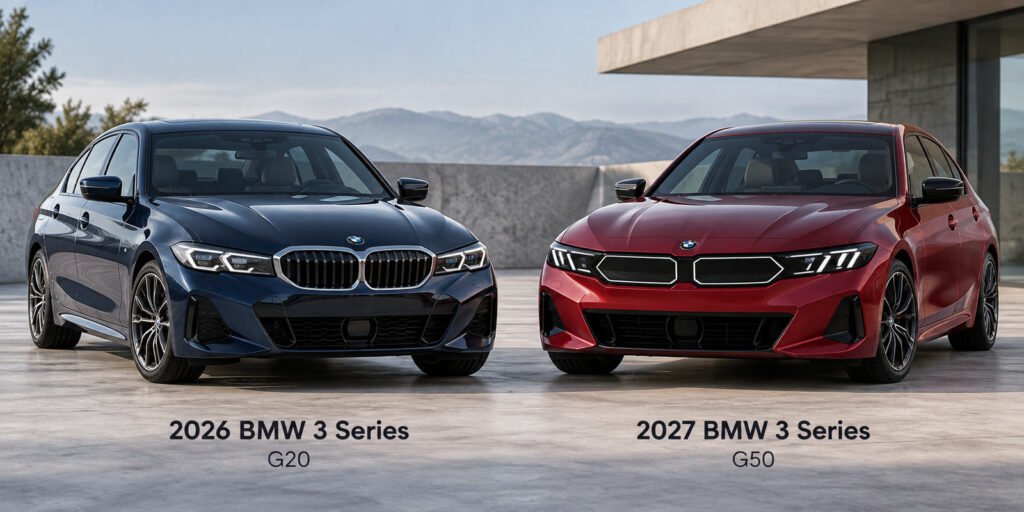
BMW has completely redesigned the 3 Series for 2027, but the most interesting change isn’t its futuristic dashboard or sharper exterior. It’s how differently the new generation treats its two main types of buyers.
The entry-level 2027 BMW 330 costs $1,900 more than its 2026 predecessor without gaining horsepower. Meanwhile, the new M350 xDrive delivers 51 additional horsepower over the outgoing M340i xDrive for just $1,600 more.
That creates an unusual buying decision. Depending on which engine you want, the 2026 BMW 3 Series could be the smarter purchase, or the 2027 redesign could justify its higher price before you even consider the new technology.
What’s Actually New for the 2027 BMW 3 Series?
The 2027 BMW 3 Series introduces the eighth-generation G50 platform for gasoline models, replacing the G20 generation that debuted for 2019.
BMW has adopted its Neue Klasse design language, creating a substantially different appearance with slimmer lighting, a reinterpreted kidney grille, sculpted bodywork and flush-fitting door handles.
The redesign extends beneath the bodywork. BMW has revised the chassis, steering and suspension architecture while introducing its Panoramic iDrive digital cockpit.
The lineup also expands beyond gasoline engines for the first time with the fully electric BMW i3, which uses a separate EV-focused architecture.
Unlike a typical model-year refresh, the 2027 update changes nearly every major part of the ownership experience. However, those changes are more significant for some configurations than others.
2027 BMW 3 Series vs 2026 Price Comparison
BMW has kept the redesigned sedan’s price increases relatively modest considering the generational changes.
Here are the confirmed U.S. starting prices, including destination charges:
| 2026 Model | 2026 Price | 2027 Replacement | 2027 Price |
|---|---|---|---|
| 330i | $49,350 | 330 | $51,250 |
| 330i xDrive | $51,350 | 330 xDrive | $53,250 |
| M340i xDrive | $65,650 | M350 xDrive | $67,250 |
Both four-cylinder variants increase by $1,900, while the six-cylinder performance model rises by $1,600.
There’s another important difference: the 2026 M340i offers a rear-wheel-drive configuration, but the 2027 M350 comes exclusively with xDrive all-wheel drive at launch.
These figures represent manufacturer pricing rather than negotiated dealership prices. A discounted outgoing model could change the comparison considerably, particularly when optional equipment is involved.
U.S. sales of the redesigned sedan are scheduled to begin during the first quarter of 2027.
BMW 330 vs 330i: New Design, Same Power
Anyone expecting substantially better acceleration from the entry-level redesign may be surprised.
Both the 2026 BMW 330i and 2027 BMW 330 use a turbocharged 2.0-liter four-cylinder engine producing 255 horsepower and 295 lb-ft of torque.
An eight-speed automatic transmission remains standard, and buyers can choose rear-wheel drive or xDrive all-wheel drive.
According to BMW’s published acceleration estimates, the outgoing 330i reaches 60 mph in 5.6 seconds, while the redesigned 330 takes 5.9 seconds.
The AWD comparison follows a similar pattern: 5.4 seconds for the 2026 330i xDrive versus 5.9 seconds for its successor.
Both generations employ 48-volt mild-hybrid technology to assist their gasoline engines. Neither is a plug-in hybrid, so owners don’t need to charge the vehicle externally.
The important distinction is that the newer 330 prioritizes updated technology and overall refinement rather than additional straight-line performance.
Buyers who primarily want a responsive luxury sedan may find the outgoing 330i delivers much of what they need at a lower price.
2027 M350 vs 2026 M340i: Where the Upgrade Gets Serious
The six-cylinder comparison tells a completely different story.
The 2026 BMW M340i xDrive produces 386 horsepower and 398 lb-ft of torque from its turbocharged 3.0-liter inline-six.
For 2027, BMW replaces it with the M350 xDrive, generating 437 horsepower and 428 lb-ft of torque.
That’s a 51-horsepower increase without a dramatic jump in price.
BMW estimates the M350 can accelerate from 0–60 mph in 3.9 seconds, compared with 4.1 seconds for the outgoing M340i xDrive.
The new model also includes Adaptive M Suspension, variable sport steering, an M Sport differential and upgraded chassis reinforcement as standard equipment.
BMW is introducing a Drift Moment feature that can direct power to the rear wheels. However, the feature is scheduled for availability during 2027 rather than necessarily being active on every initial delivery.
The M350 remains an M Performance sedan, not a replacement for the full M3.
For buyers prioritizing acceleration and performance equipment, the new M350 presents a substantially stronger upgrade argument than the four-cylinder 330.
Interior Comparison: Familiar Controls or BMW’s Digital Future?
The dashboard may be the most divisive part of this generational change.
The 2026 BMW 3 Series features a curved display combining a 12.3-inch digital instrument cluster and a 14.9-inch central touchscreen running BMW’s iDrive system.
For 2027, BMW removes the conventional instrument-cluster display and introduces Panoramic Vision, projecting driving information across the lower windshield.
A new 17.9-inch central touchscreen runs BMW Operating System X, while an additional 3D head-up display is available.
Wireless Apple CarPlay and Android Auto remain standard.
The redesigned cabin includes standard electrically adjustable front seats with memory, wireless phone charging, two-zone climate control and a panoramic glass roof. Three-zone climate control, heated rear seats and ventilated front seats are available depending on equipment.
Physical controls remain for selected functions, including audio volume and hazard lights, but much of the interface relies on digital controls.
The 2026 cabin is therefore a reasonable choice for someone who prefers a more familiar dashboard layout. Buyers attracted to extensive personalization and windshield-based displays may prefer 2027.
Neither approach is automatically more convenient. That depends on how naturally the driver interacts with the controls.
Exterior Size, Rear Seats and Everyday Practicality
The redesigned gasoline 3 Series is slightly longer and wider, with a modestly extended wheelbase.
The 2026 sedan measures 185.9 inches long and provides 16.9 cubic feet of trunk capacity.
Although the newer dimensions suggest a larger exterior footprint, that doesn’t automatically translate into substantially more rear-seat room or usable luggage space.
Comparable final U.S. cargo measurements for the 2027 gasoline model still need verification.
Both generations retain a traditional five-seat sedan layout, making them practical for couples or smaller families. However, buyers regularly installing child seats should compare actual rear-door access and legroom rather than relying on exterior measurements.
Fuel Economy and the New Electric BMW i3
Fuel efficiency presents another reason not to assume the redesign is automatically superior.
The rear-wheel-drive 2026 BMW 330i has EPA ratings of 28 mpg city, 35 mpg highway and 31 mpg combined.
Final U.S. EPA figures for the redesigned 2027 gasoline models were not available at the time of writing, preventing a reliable direct MPG comparison.
Both generations use mild-hybrid assistance, but the 2027 lineup introduces a separate alternative for buyers who want to stop purchasing gasoline entirely.
The new BMW i3 50 xDrive develops 463 horsepower through a dual-motor electric drivetrain.
BMW estimates its electric range at approximately 446–468 miles, based on preliminary testing using EPA procedures. These are manufacturer estimates, not finalized EPA ratings.
The i3 also supports DC fast charging at up to 400 kW under suitable conditions.
Starting at $62,850 including destination, it offers an entirely different proposition from either gasoline 3 Series. Buyers with dependable charging access should consider it separately rather than treating it as another engine trim.
Safety, Reliability and Ownership Costs
The 2027 BMW 3 Series introduces updated driver-assistance technology, including an available hands-free Highway Assist system operating on suitable highways at speeds up to 85 mph.
Driver attention remains required; this is not autonomous driving.
New-generation U.S. crash-test results and long-term reliability evidence are not yet sufficient for definitive comparisons with the outgoing sedan.
BMW’s established U.S. new-vehicle coverage includes a four-year/50,000-mile limited warranty and a three-year/36,000-mile scheduled-maintenance program, subject to applicable terms.
With either generation, buyers should also consider insurance, premium fuel, tire replacement and the cost of optional equipment.
An established generation offers more historical ownership information, but that alone does not establish that it will be more reliable.
Should You Buy a 2026 BMW 3 Series or Wait for 2027?
The answer depends heavily on your preferred trim.
Choose the 2026 BMW 330i if you want a capable gasoline sports sedan, prefer its current interior arrangement, or find a worthwhile dealership discount. The new 330 doesn’t offer a horsepower advantage.
Wait for the 2027 BMW M350 xDrive if six-cylinder performance is your priority. The additional power and expanded standard performance equipment make its relatively small price increase compelling.
Consider the 2027 BMW 330 if you strongly prefer the redesigned styling, panoramic displays and newer driver-assistance technology.
The strongest buying strategy is to compare actual equipment and final transaction prices, rather than deciding solely from model-year labels.
Frequently Asked Questions
When will the 2027 BMW 3 Series be available?
BMW has scheduled the U.S. launch of the 330, 330 xDrive, M350 xDrive and electric i3 50 xDrive for the first quarter of 2027.
Is the 2027 BMW 3 Series faster than the 2026 model?
The M350 is quicker according to BMW’s estimates, but the entry-level 2027 330 has a slower published 0–60 mph time than the outgoing 330i.
Does the 2027 BMW 3 Series offer a manual transmission?
No. The confirmed gasoline launch models use eight-speed automatic transmissions.
Can you buy a rear-wheel-drive 2027 BMW M350?
No. The 2027 M350 comes standard with xDrive, although its planned Drift Moment feature enables a rear-wheel-drive operating mode.
Does the 2027 BMW 3 Series require charging?
The gasoline 330 and M350 mild hybrids do not require external charging. The fully electric BMW i3 uses plug-in charging.
TillDrive Verdict: Which BMW 3 Series Makes More Sense?
The 2027 BMW 3 Series represents a significant technological redesign, but the value of upgrading isn’t equal across the lineup.
The outgoing 2026 330i remains attractive when priced competitively, offering the same horsepower and a familiar cabin. However, the 2027 M350 provides substantially more performance for a relatively modest additional investment.
For most performance-focused buyers, the M350 is worth serious consideration. For entry-level shoppers, a well-priced 2026 330i may be the more financially sensible choice.
The biggest unanswered question is how the redesigned chassis and controls compare in everyday driving.
2027 BMW 3 Series vs 2026 Quick Specs
| Specification | 2026 BMW 330i | 2027 BMW 330 |
|---|---|---|
| Vehicle type | Luxury sports sedan | Luxury sports sedan |
| Generation | G20 | G50 |
| Engine | 2.0L turbo I4 | 2.0L turbo I4 |
| Hybrid system | 48V mild hybrid | 48V mild hybrid |
| Horsepower | 255 hp | 255 hp |
| Torque | 295 lb-ft | 295 lb-ft |
| Transmission | 8-speed automatic | 8-speed automatic |
| Drivetrain | RWD / optional AWD | RWD / optional AWD |
| 0–60 MPH (RWD) | 5.6 sec | 5.9 sec |
| Combined MPG (RWD) | 31 EPA | Pending |
| Seating capacity | 5 | 5 |
| Cargo capacity | 16.9 cu ft | Not yet verified |
| Starting U.S. price | $49,350 | $51,250 |
| Specification | 2026 M340i xDrive | 2027 M350 xDrive |
|---|---|---|
| Engine | 3.0L turbo inline-six | 3.0L turbo inline-six |
| Hybrid system | 48V mild hybrid | 48V mild hybrid |
| Horsepower | 386 hp | 437 hp |
| Torque | 398 lb-ft | 428 lb-ft |
| Transmission | 8-speed automatic | 8-speed automatic |
| Drivetrain | AWD | AWD |
| 0–60 MPH | 4.1 sec | 3.9 sec |
| Adaptive M Suspension | Available equipment | Standard |
| Top speed | Electronically limited; configuration dependent | Up to 155 mph with sport tires |
| Starting U.S. price | $65,650 | $67,250 |
Prices include destination charges and exclude taxes, registration and optional equipment. Acceleration figures are manufacturer estimates. Specifications reflect information available as of October 11, 2026.