Nissan is taking an unusual approach to the hybrid SUV market. Its all-new 2027 Rogue Hybrid runs entirely on electric-motor propulsion, yet never needs a charging cable. Toyota’s redesigned RAV4 Hybrid follows a more familiar formula, combining gasoline and electric power to deliver impressive fuel economy.
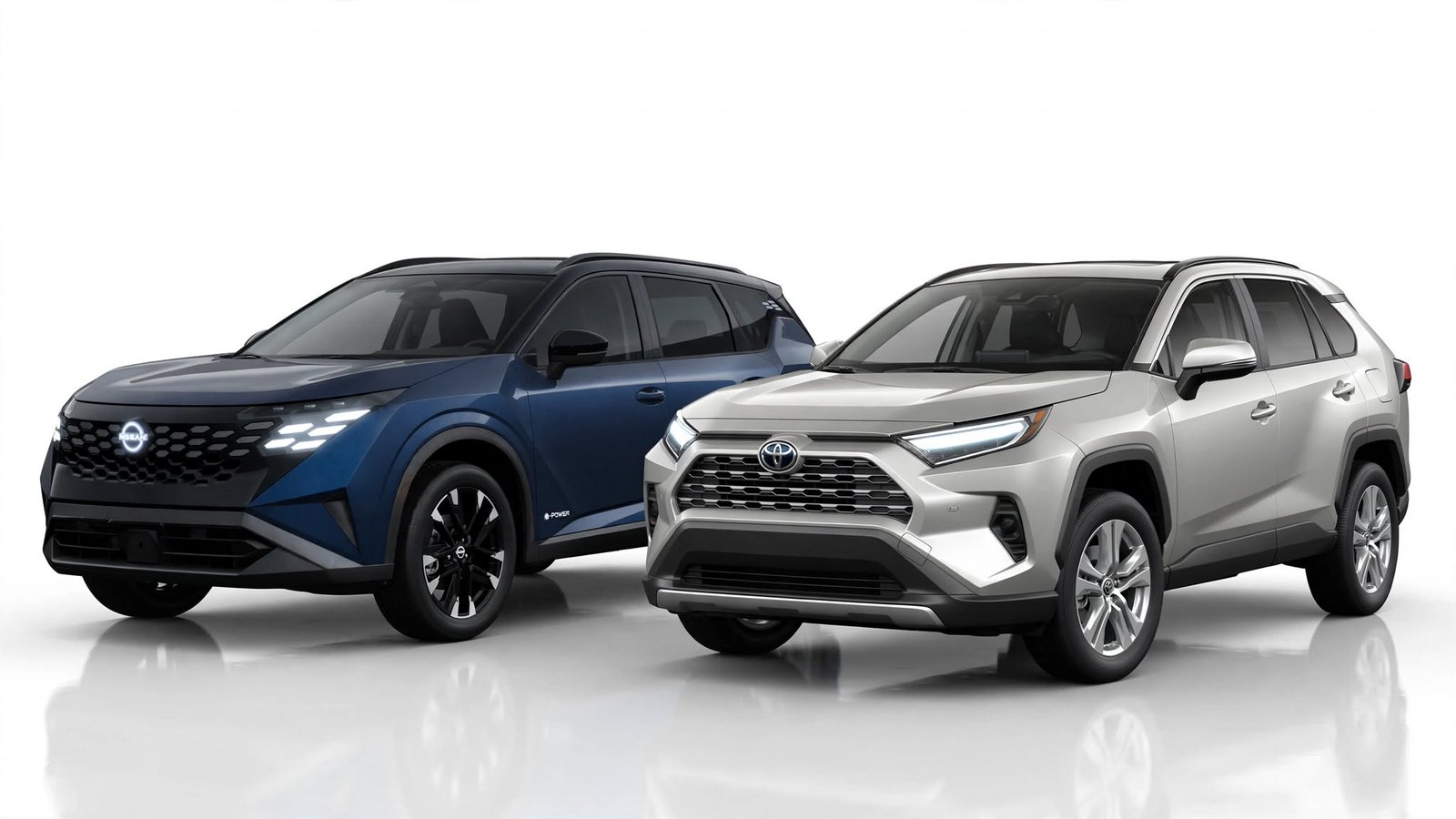
Both promise the convenience of a conventional SUV with lower fuel consumption, but their engineering, pricing and everyday advantages are noticeably different.
The important distinction is availability. Nissan has revealed its 2027 model, while Toyota’s latest complete U.S. consumer specifications cover the 2026 RAV4. That makes the 2026 Toyota the verified benchmark for this comparison.
What Is Actually Confirmed for 2027?
The 2027 Nissan Rogue Hybrid was officially unveiled in September 2026. Its initial U.S. arrival is scheduled for November 2026, starting with the SR Technology Package in limited quantities. The remaining SV, SR and Platinum versions are expected in January 2027.
Toyota introduced the sixth-generation RAV4 for 2026, giving it an entirely electrified lineup, updated styling and new technology. The regular hybrid is already part of Toyota’s U.S. retail range.
Although Toyota’s fleet scheduling information references 2027 RAV4 production, complete public retail pricing and trim specifications for the 2027 model have not been established.
Consequently, the Toyota figures below refer to the confirmed 2026 RAV4 Hybrid unless otherwise indicated. They should not be mistaken for finalized 2027 specifications.
Nissan e-POWER vs Toyota Hybrid: Two Different Ways to Save Fuel
Nissan’s Electric-Drive Approach
The Rogue Hybrid uses Nissan’s third-generation e-POWER system. A 1.5-liter turbocharged three-cylinder gasoline engine generates electricity, while two electric motors propel the vehicle.
Combined output reaches 225 horsepower, and every trim includes dual-motor all-wheel drive.
Unlike a conventional gasoline SUV, the Rogue has no traditional shifting transmission connecting its gasoline engine to the wheels. This arrangement is designed to deliver immediate electric-motor response without requiring external charging.
Nissan also includes e-Pedal technology, allowing drivers to decelerate to a complete stop by releasing the accelerator, along with Smooth Stop braking assistance.
The expected advantage is smoother low-speed operation, although independent testing is needed to determine how effectively that translates into everyday driving.
Toyota’s Conventional Hybrid System
The redesigned RAV4 Hybrid combines a 2.5-liter naturally aspirated four-cylinder engine with Toyota’s fifth-generation hybrid technology and an electronically controlled continuously variable transmission.
Front-wheel-drive versions produce 226 horsepower, while all-wheel-drive models generate 236 horsepower.
Toyota’s system can use gasoline and electric propulsion together, with power delivery managed automatically to balance performance and efficiency.
Neither SUV requires plugging in. However, Nissan’s electric-only wheel propulsion makes the Rogue mechanically different from the Toyota, even though both are classified as conventional hybrids.
Fuel Economy: Does Toyota Still Have the Advantage?
Efficiency is one of the clearest differences between these SUVs.
Nissan estimates the Rogue Hybrid SR AWD will achieve 41 MPG city, 36 MPG highway and 38 MPG combined. The SV and Platinum are estimated at 37 MPG combined.
Toyota’s 2026 RAV4 Hybrid offers up to 43 MPG combined in front-wheel-drive configurations. The LE AWD achieves 42 MPG combined, while other AWD trims vary, with the Woodland returning approximately 38 MPG combined.
Comparing AWD models is particularly revealing. Toyota’s LE AWD has a four-MPG combined advantage over the Rogue SR, while some higher-trim Toyota configurations have a smaller advantage.
The Nissan carries a 14.0-gallon fuel tank compared with the Toyota’s 14.5 gallons. Actual driving range will depend on traffic, temperature, speed and driving habits.
Importantly, Nissan’s Rogue figures remain manufacturer estimates rather than final EPA-certified ratings. Toyota’s available ratings provide a firmer efficiency benchmark.
For buyers primarily concerned with minimizing fuel expenses, the RAV4 currently has the stronger numerical argument.
Price and Trims: Which Hybrid Gives You More?
The 2027 Nissan Rogue Hybrid starts at $35,490 for the SV AWD. The SR costs $37,490, while the Platinum reaches $43,490.
An SV Premium Package costs $2,100, and the SR Technology Package adds $4,000. Nissan also charges $1,575 for destination and handling.
Toyota’s confirmed 2026 RAV4 Hybrid starts at $31,900 for the LE FWD or $33,300 for the LE AWD, before applicable delivery fees.
That puts the entry-level AWD Toyota $2,190 below the Rogue SV AWD before destination charges.
However, the price difference becomes less obvious higher in the lineup. Toyota’s XLE Premium AWD starts at $37,500, almost identical to the Rogue SR AWD.
Nissan’s SV already includes heated front seats, wireless smartphone integration and a 12.3-inch touchscreen. Higher trims introduce larger displays, upgraded upholstery and more advanced driver assistance.
Toyota counters with more trim and drivetrain choices, allowing buyers to prioritize affordability, efficiency or equipment.
The Rogue SV AWD looks like Nissan’s strongest initial value, while the RAV4 LE AWD is a compelling lower-priced alternative. Buyers wanting extra comfort should compare the Rogue SR against the Toyota XLE Premium AWD.
Interior, Technology and Family Practicality
Both SUVs seat five passengers, but their interiors prioritize different experiences.
The Rogue Hybrid includes a standard 12.3-inch infotainment touchscreen, wireless Apple CarPlay, wireless Android Auto and wireless phone charging. Higher specifications offer dual 14.3-inch displays, Google built-in navigation and a Bose premium audio system.
Nissan also retains physical controls for important functions, potentially making routine adjustments easier without navigating touchscreen menus.
The redesigned Toyota RAV4 features a standard 10.5-inch infotainment display, an available 12.9-inch screen and a 12.3-inch digital instrument cluster.
Wireless smartphone integration is standard. Toyota also introduces updated connected services and software architecture, although some functions depend on subscriptions.
One notable usability distinction concerns climate controls. Toyota integrates several functions into its touchscreen while retaining selected physical controls.
Cargo Space and Family Features
The 2026 RAV4 provides 37.8 cubic feet of cargo capacity behind its second row and up to 70.4 cubic feet with the rear seats folded.
Nissan lists 34.4 cubic feet behind the Rogue’s second row with the seats in their forward-most position, expanding to 65.9 cubic feet when folded. Because manufacturers may measure cargo space differently, these figures are useful guides rather than exact luggage-fitting comparisons.
Nissan’s rear doors open nearly 90 degrees, improving access when installing child seats. Its LATCH arrangement also supports flexible center-seat installation.
For towing, the Rogue Hybrid is rated for 1,500 pounds when properly equipped. Certain 2026 RAV4 Hybrid AWD configurations can tow up to 3,500 pounds, although the LE AWD is rated at 1,750 pounds.
The Rogue generally includes a tire repair kit rather than a conventional spare, with a temporary spare available as an accessory on Platinum. That detail matters for buyers traveling far from roadside assistance.
Safety, Reliability and Hybrid Battery Warranties
Nissan equips the Rogue Hybrid with modern driver assistance, including automatic emergency braking, blind-spot monitoring and ProPILOT Assist.
Higher trims introduce Auto Lane Change and hands-off assistance in qualifying low-speed traffic conditions on divided highways. These remain supervised assistance features, not autonomous driving.
Toyota’s redesigned RAV4 introduces Toyota Safety Sense 4.0, featuring updated collision avoidance, adaptive cruise control and lane assistance.
Neither vehicle’s electronic safety features should be confused with independent crash-test performance. Model-specific safety ratings must be evaluated separately as testing becomes available.
Reliability also requires caution.
Nissan has sold nearly two million e-POWER-equipped vehicles globally across earlier generations, providing considerable experience with the technology. However, that history does not establish long-term reliability for the newly introduced U.S. Rogue Hybrid.
Toyota has extensive conventional-hybrid experience, but its redesigned RAV4 powertrain and electronics still warrant long-term observation.
Warranty coverage provides a clearer distinction.
The Rogue Hybrid battery receives eight years or 100,000 miles of limited coverage. Toyota’s 2026 hybrid battery warranty extends to ten years or 150,000 miles.
Both brands generally provide three-year/36,000-mile basic warranties and five-year/60,000-mile powertrain warranties.
Toyota offers longer confirmed hybrid-battery protection, but warranty length alone cannot predict repair frequency.
Which SUV Should You Buy, and Is Waiting Worth It?
For drivers prioritizing fuel efficiency and initial purchase price, the currently available RAV4 Hybrid makes a convincing case. Its LE AWD combines standard hybrid performance, competitive equipment and better rated economy than Nissan’s estimates.
The Rogue Hybrid becomes more interesting for shoppers who specifically want electric-motor propulsion, standard AWD and available advanced cabin technology.
Families should compare rear-seat access and cargo layouts in person. Nissan’s wide-opening rear doors are convenient, while the Toyota offers greater published cargo volume.
Waiting also requires perspective. Nissan’s lower-priced trims are not expected until early 2027, and Toyota’s full 2027 retail specifications remain unconfirmed.
A shopper needing a vehicle immediately has more concrete information about the 2026 RAV4 than either upcoming model.
Frequently Asked Questions
Does the 2027 Nissan Rogue Hybrid need charging?
No. Its gasoline engine generates electricity for the battery and electric motors. Owners refuel at regular gas stations without external charging.
Is the 2027 Rogue Hybrid available with front-wheel drive?
No. All announced U.S. Rogue Hybrid trims include standard dual-motor all-wheel drive.
Does the Nissan Rogue Hybrid require premium gasoline?
No. The 2027 Rogue Hybrid is designed to operate on regular unleaded gasoline.
Which SUV has the longer hybrid battery warranty?
Toyota’s confirmed 2026 RAV4 Hybrid coverage is ten years or 150,000 miles. Nissan provides eight years or 100,000 miles on the 2027 Rogue Hybrid battery.
Is the 2027 Toyota RAV4 Hybrid officially priced?
A complete official U.S. 2027 RAV4 Hybrid retail price list has not been verified. The confirmed 2026 regular hybrid starts at $31,900.
TillDrive Editorial Verdict
The 2027 Nissan Rogue Hybrid introduces a compelling alternative to the familiar Toyota hybrid formula. Its electric-motor drivetrain, standard AWD and generous technology equipment give buyers reasons to consider it beyond fuel savings.
However, the RAV4 currently offers stronger verified fuel-economy figures, a lower entry price and longer hybrid-battery coverage.
For value and efficiency, the Toyota RAV4 Hybrid is the safer recommendation based on currently published information. For electric-drive character and standard AWD, the new Rogue deserves serious consideration once independent testing becomes available.
2027 Nissan Rogue Hybrid vs Toyota RAV4 Hybrid Quick Specs
| Specification | 2027 Nissan Rogue Hybrid | 2026 Toyota RAV4 Hybrid |
|---|---|---|
| Manufacturer | Nissan | Toyota |
| Vehicle Type | Compact hybrid SUV | Compact hybrid SUV |
| Engine | 1.5L turbocharged 3-cylinder generator | 2.5L 4-cylinder hybrid |
| Horsepower | 225 hp | 226 hp FWD / 236 hp AWD |
| Hybrid System | Series hybrid, e-POWER | Conventional hybrid |
| Transmission | Electric drive, no conventional shifting transmission | eCVT |
| Drivetrain | Standard AWD | FWD or AWD |
| Combined MPG | 37–38, Nissan estimate | 38–43, varies by trim |
| Fuel Tank | 14.0 gallons | 14.5 gallons |
| Seating Capacity | 5 | 5 |
| Cargo Behind Rear Seats | 34.4 cu ft, seats forward-most | 37.8 cu ft |
| Maximum Cargo | 65.9 cu ft | 70.4 cu ft |
| Towing Capacity | 1,500 lb | Up to 3,500 lb |
| Base Touchscreen | 12.3 inches | 10.5 inches |
| Starting MSRP | $35,490 AWD | $31,900 FWD / $33,300 AWD |
| Hybrid Battery Warranty | 8 years / 100,000 miles | 10 years / 150,000 miles |
| 2027 U.S. Retail Details | Officially announced | Complete specifications not yet verified |
Note: Toyota specifications refer to the officially documented 2026 RAV4 Hybrid. Nissan fuel-economy figures are manufacturer estimates pending final EPA confirmation. Pricing excludes applicable destination charges, taxes and dealer fees.