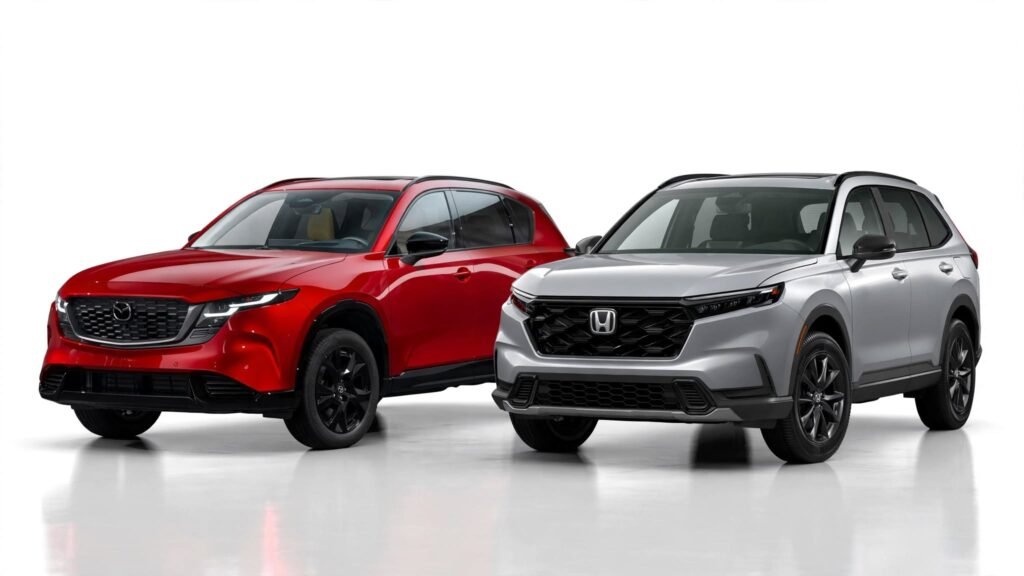
The Mazda CX-5 has finally addressed one of its biggest weaknesses: space. Its redesigned body brings a longer wheelbase, more rear-seat room, and a modern interior that looks considerably different from its predecessor. But the Honda CR-V still has an advantage that matters to thousands of SUV buyers: an established hybrid powertrain with excellent fuel economy.
The 2027 Mazda CX-5 vs Honda CR-V comparison therefore goes beyond styling and horsepower. It is a choice between Mazda’s redesigned approach to comfort and technology and Honda’s emphasis on efficiency and practicality.
There is one important distinction: Honda has published its 2027 specifications, while Mazda’s confirmed U.S. specifications currently concern the redesigned 2026 gasoline CX-5. Its new hybrid is planned for 2027.
What’s Actually New for 2027?
Mazda introduced the third-generation CX-5 for 2026, substantially improving the dimensions, cabin design, and technology of its best-selling crossover. The redesign includes a longer wheelbase, wider rear-door openings, and a completely revised dashboard.
Honda’s 2027 CR-V largely continues the sixth-generation formula, offering gasoline and hybrid engines across seven trims.
Mazda’s biggest upcoming change is its proprietary hybrid system paired with the new Skyactiv-Z engine, scheduled for introduction by the end of calendar year 2027.
However, Mazda has not confirmed complete U.S. hybrid specifications, pricing, or a precise launch date. The vehicle’s eventual U.S. model-year designation also remains to be established.
For now, Honda offers the more complete purchasing picture.
Price Comparison: Where Your Money Goes Further
Mazda’s redesigned 2026 CX-5 starts at $29,990, including standard all-wheel drive. Honda’s 2027 CR-V starts at $31,520 with front-wheel drive.
That difference becomes more interesting when comparing AWD models.
The 2027 CR-V LX AWD costs $33,020, making Mazda’s base AWD SUV $3,030 less expensive before destination charges.
| Trim | Starting MSRP |
|---|---|
| Mazda CX-5 2.5 S (2026) | $29,990 |
| Mazda CX-5 Select (2026) | $31,990 |
| Mazda CX-5 Preferred (2026) | $34,250 |
| Mazda CX-5 Premium (2026) | $36,900 |
| Mazda CX-5 Premium Plus (2026) | $38,990 |
| Honda CR-V LX FWD (2027) | $31,520 |
| Honda CR-V EX FWD (2027) | $33,550 |
| Honda CR-V EX-L FWD (2027) | $35,800 |
| Honda CR-V Sport Hybrid FWD (2027) | $36,030 |
| Honda CR-V TrailSport Hybrid AWD (2027) | $39,200 |
| Honda CR-V Sport-L Hybrid FWD (2027) | $39,125 |
| Honda CR-V Sport Touring Hybrid AWD (2027) | $42,950 |
These are U.S. manufacturer suggested retail prices excluding destination charges, taxes, and options. Mazda’s figures are for 2026, not announced 2027 pricing.
Mazda’s Preferred trim offers an appealing equipment balance, including heated front seats, a heated steering wheel, power liftgate, and head-up display.
Honda’s Sport Hybrid, meanwhile, presents a stronger argument for buyers willing to spend more upfront to reduce fuel consumption.
Engines and Driving Character: Conventional vs Electrified
The redesigned gasoline CX-5 uses Mazda’s naturally aspirated 2.5-liter four-cylinder engine, producing 187 horsepower and 186 lb-ft of torque. A six-speed automatic transmission sends power to all four wheels.
Honda offers two distinct options.
Its gasoline CR-V uses a turbocharged 1.5-liter engine producing 190 horsepower and 179 lb-ft of torque, paired with a continuously variable transmission.
The CR-V Hybrid combines a 2.0-liter gasoline engine with Honda’s two-motor hybrid system, delivering 204 total system horsepower.
The Mazda’s traditional automatic provides defined gear changes, while Honda’s gasoline CVT prioritizes smooth operation and efficiency.
Independent testing of the redesigned 2026 CX-5 recorded approximately eight seconds to reach 60 mph, placing it close to tested gasoline CR-V configurations. Those results should not be mistaken for official 2027 acceleration figures.
Mazda’s updated suspension and G-Vectoring Control Plus also support its emphasis on controlled handling. Honda takes a more comfort-oriented approach, particularly in its spacious, family-focused configurations.
Neither gasoline model is designed for high-performance driving. Both offer sufficient output for ordinary highway travel, but the CR-V Hybrid provides an appealing combination of electric-assisted acceleration and efficiency.
Fuel Economy: Honda Has the Numbers, Mazda Has a Question Mark
Fuel economy is currently Honda’s clearest advantage.
The redesigned gasoline Mazda CX-5 achieves an EPA-estimated 24 mpg city, 30 highway, and 26 combined.
Honda’s 2027 gasoline CR-V achieves 30 mpg combined with FWD or 29 mpg with AWD.
The hybrid extends that advantage considerably.
| Configuration | Combined MPG |
|---|---|
| Mazda CX-5 2.5 AWD (2026) | 26 |
| Honda CR-V 1.5T FWD | 30 |
| Honda CR-V 1.5T AWD | 29 |
| Honda CR-V Sport Hybrid FWD | 40 |
| Honda CR-V Hybrid AWD | 37 |
| Honda CR-V TrailSport Hybrid AWD | 35 |
The front-wheel-drive CR-V Hybrid consumes roughly 35% less fuel per mile than the gasoline Mazda, based on their EPA combined ratings. This is a comparison of different drivetrain configurations, not equivalent hybrid models.
Should You Wait for the Mazda CX-5 Hybrid?
Waiting makes sense if you particularly value Mazda’s cabin design and want better fuel efficiency without switching manufacturers.
But until Mazda publishes official horsepower, MPG, battery, and pricing figures, there is no credible basis for claiming its future hybrid will outperform Honda’s.
Buyers who need an efficient SUV immediately have a verified option in the CR-V Hybrid.
Interior and Technology: A Big Touchscreen Isn’t Always Better
The redesigned CX-5 introduces a 12.9-inch standard touchscreen, with a larger 15.6-inch display available on the Premium Plus.
Google built-in technology brings navigation, voice assistance, and connected features, although certain services require a subscription after the included trial.
Mazda also offers ventilated front seats, a panoramic moonroof, ambient lighting, Bose audio, and a 360-degree camera on selected trims.
Honda takes a different approach.
Every 2027 CR-V includes a 9-inch touchscreen with wireless Apple CarPlay and Android Auto. Physical climate controls remain accessible beneath the display, making routine adjustments more straightforward.
The CR-V also includes wireless phone charging, while Google built-in is reserved for the Sport Touring Hybrid.
Mazda’s larger screens create a more dramatic first impression, but its increased reliance on touchscreen controls may frustrate drivers who prefer conventional buttons.
Honda offers a less visually ambitious dashboard but keeps familiar functions easy to reach.
Both SUVs provide USB-C charging, heated seating on selected trims, and premium audio options.
Cargo Space and Family Practicality
Although Mazda enlarged the CX-5, Honda still offers more luggage capacity.
The redesigned Mazda provides 33.7 cubic feet behind its rear seats, increasing to 66.5 cubic feet with them folded.
The gasoline CR-V offers 39.3 cubic feet behind the second row, while most hybrid trims provide 36.3 cubic feet. The Sport Touring Hybrid has 34.7 cubic feet.
Honda therefore retains an advantage for bulky shopping, luggage, and family equipment.
Rear legroom is competitive in both vehicles. Mazda provides approximately 39.9 inches, while Honda offers 41 inches.
Mazda’s 40/20/40-split rear seats offer flexibility for carrying longer objects while retaining outboard seating. Honda uses a 60/40 arrangement.
Both SUVs accommodate five occupants and provide child-seat attachment points, although buyers should check their particular child seats for fit.
Towing also deserves attention. The gasoline CX-5 and CR-V can each tow up to 1,500 pounds when properly equipped, while Honda limits its CR-V Hybrid to 1,000 pounds.
For families regularly carrying large items, the CR-V remains the more practical choice.
Safety: A Comparison With an Unexpected Result
Mazda’s redesigned 2026 CX-5 earned the IIHS Top Safety Pick+ award, receiving Good ratings in the updated moderate-overlap, small-overlap, and side crash tests.
The IIHS ratings applying to the 2027 Honda CR-V tell a more complicated story.
Honda received Good ratings in the small-overlap front and updated side tests, but Poor in the updated moderate-overlap front test.
That result should not be overlooked simply because the CR-V has a strong overall reputation.
Mazda also includes blind-spot monitoring, adaptive cruise control, emergency braking, and rear cross-traffic alerts across its redesigned gasoline lineup.
Honda provides standard Honda Sensing features, including automatic emergency braking, adaptive cruise control, and lane-keeping assistance, although blind-spot monitoring is not standard on the LX.
Mazda’s 2026 crash-test award should not automatically be assigned to the 2027 model until its applicable rating is confirmed.
Reliability, Maintenance and Long-Term Ownership
Both manufacturers have established service networks and extensive experience producing compact SUVs, but long-term reliability cannot be determined from reputation alone.
Mazda’s current naturally aspirated engine and conventional automatic use familiar technology. Honda’s gasoline turbocharged engine and two-motor hybrid have also been used across multiple model years.
Routine maintenance, tire replacement, insurance, and fuel consumption will influence ownership expenses.
The CR-V Hybrid’s fuel savings can be meaningful for high-mileage drivers, although purchase price and local gasoline costs determine whether those savings offset its premium.
Mazda’s upcoming hybrid deserves particular caution: its new engine and proprietary electrified system have not yet accumulated long-term ownership data.
For either SUV, buyers should review warranty terms, current recalls, service requirements, and actual dealer pricing before purchase.
Frequently Asked Questions
Is the 2027 Mazda CX-5 Hybrid confirmed?
Mazda has confirmed plans to introduce its Skyactiv-Z-based hybrid system by the end of 2027, but full U.S. specifications and launch details remain unavailable.
Does the Honda CR-V Hybrid need charging?
No. The CR-V uses a conventional self-charging hybrid system. Its battery is charged through the gasoline engine and regenerative braking, without external plugging.
Which SUV has better fuel economy?
The 2027 Honda CR-V Hybrid reaches 40 mpg combined with front-wheel drive. Mazda has not announced official EPA figures for its upcoming hybrid.
Does the Mazda CX-5 have standard AWD?
Yes. The redesigned 2026 U.S.-market gasoline CX-5 includes standard all-wheel drive. Honda offers FWD and AWD configurations, depending on trim.
Which SUV has more cargo space?
The Honda CR-V offers more cargo volume behind the rear seats, particularly in gasoline configurations.
Can either SUV use regular gasoline?
Yes. The published gasoline Mazda CX-5 and 2027 Honda CR-V specifications permit regular unleaded gasoline.
TillDrive Verdict: Which SUV Should You Choose?
The Honda CR-V is the stronger choice for buyers prioritizing fuel economy, cargo capacity, and an available hybrid powertrain with established specifications.
Mazda’s redesigned CX-5 makes a compelling case through standard AWD, competitive pricing, impressive available technology, and favorable 2026 crash-test results.
For gasoline buyers, the CX-5 Preferred deserves serious consideration. For efficiency-focused shoppers, the CR-V Sport Hybrid provides a particularly attractive balance.
Mazda’s upcoming hybrid could change the comparison, but choosing it on performance or fuel-economy promises before specifications are published would be premature.
2027 Mazda CX-5 vs Honda CR-V Quick Specs
Important: Mazda figures below describe the redesigned 2026 U.S. gasoline CX-5. Complete 2027 Mazda specifications have not been announced.
| Specification | Mazda CX-5 (2026 reference) | Honda CR-V (2027) |
|---|---|---|
| Vehicle type | Compact SUV | Compact SUV |
| Gasoline engine | 2.5L naturally aspirated I4 | 1.5L turbocharged I4 |
| Gas horsepower | 187 hp | 190 hp |
| Gas torque | 186 lb-ft | 179 lb-ft |
| Hybrid horsepower | Not announced | 204 hp |
| Transmission | 6-speed automatic | CVT / hybrid electric drive |
| Drivetrain | Standard AWD | FWD / AWD |
| Combined gasoline MPG | 26 | 29–30 |
| Combined hybrid MPG | Not announced | 35–40 |
| Fuel tank | 15.3 gallons | 14 gallons |
| Seating | 5 | 5 |
| Rear legroom | 39.9 inches | 41 inches |
| Cargo behind rear seats | 33.7 cu ft | 34.7–39.3 cu ft |
| Maximum towing | 1,500 lb | 1,500 lb gas / 1,000 lb hybrid |
| Gasoline starting MSRP | $29,990 (2026) | $31,520 (2027) |
| Hybrid starting MSRP | Not announced | $36,030 |
| 0–60 mph | Approx. 8.0 sec, independently tested 2026 gas model | Varies by powertrain; no single official figure |
| Fuel recommendation | Regular unleaded | Regular unleaded |