A redesigned dashboard may attract attention, but the rear seats decide whether a three-row SUV actually works for a family. The 2027 Volkswagen Atlas arrives with richer materials, bigger screens, and more standard comfort features while keeping the generous passenger space that made the previous model useful.
Its third row has grown only slightly, which raises a fair question: does the redesign improve family life, or mostly the view from the front seats?
The answer depends on how often you use all seven seats and what you carry behind them.
Is the 2027 Volkswagen Atlas Interior Roomier?
The second-generation Atlas looks different inside, but Volkswagen has wisely avoided sacrificing space for styling.
Front-row legroom remains 41.7 inches, with 37.6 inches in the second row and 34.1 inches in the third. Compared with 2026, the rearmost passengers gain just 0.4 inch of measured legroom. This is a refinement, not an expansion that changes who can fit.
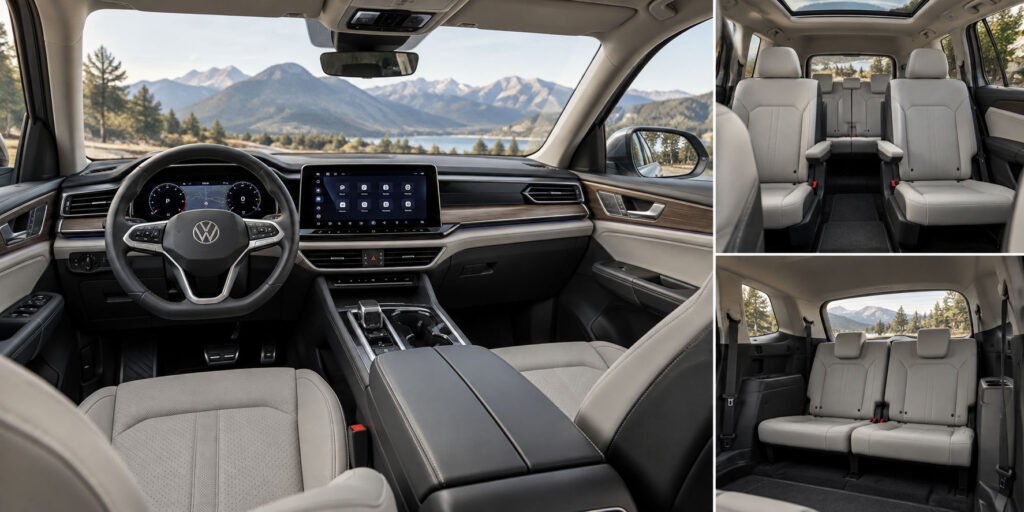
The cabin’s greatest advantage is flexibility. Second-row seats slide and recline, letting passengers negotiate how much knee room belongs to each row. Push the middle seats back and adults there can stretch out; move them forward and the third row becomes more accommodating.
The Atlas therefore rewards families willing to adjust the seating rather than treating each dimension as fixed.
An upright rear roofline also distinguishes the three-row Atlas from the sleeker two-row Atlas Cross Sport.
Third-Row Comfort: Can Adults Actually Fit?
Yes, adults can use the 2027 Atlas third row, and not merely as an emergency measure.
Its 34.1 inches of legroom compares favorably with many midsize SUVs. Recent independent evaluations found space for average-height adults, although taller occupants can encounter limited headroom and tighter foot placement around the wheel wells.
The bigger consideration is the position of the second row. A middle-row passenger who slides all the way back claims space that someone behind needs.
This arrangement should work well for children and many adults on ordinary outings, but families planning frequent long-distance trips with six or seven adults should test the seats together.
Getting there is reasonably straightforward. The second-row seats tilt and slide forward for entry, including in certain properly installed LATCH child-seat configurations.
Do not assume every restraint can move safely with the seat: check both manuals and test your actual installation.
Rear ventilation, cupholders, storage pockets, and charging access make the third row feel like an intended passenger area rather than an afterthought.
Seven Seats or Six? Choosing the Right Layout
A second-row bench gives the Atlas seven seats: two in front, three in the middle, and two at the back.
Optional second-row captain’s chairs reduce capacity to six, creating two individual middle seats and a passage between them.
The bench is the logical choice when every seat matters, especially for a family with three children using the middle row. The captain’s chairs are appealing when third-row access is a daily task, or when two older children prefer their own seating positions.
Captain’s chairs are offered beginning with the SE with Technology, rather than on the base SE.
Before choosing them, think about the moments when a seventh passenger needs a ride. There is no eight-seat Atlas.
Cargo Space With All Three Rows in Use
Cargo capacity is one of the 2027 Atlas’s most practical strengths.
It provides 21.2 cubic feet behind the third row, 55.9 cubic feet behind the second, and a maximum of 95.4 cubic feet with both rear rows folded.
That first figure matters most to families using every seat. The space can accommodate routine shopping and some travel bags, but packing for seven people still demands sensible luggage choices.
Folding the third row creates a much more forgiving load area for strollers, sports equipment, or bulky purchases.
The rear seatbacks fold to create an extended cargo floor. Still, the Atlas cannot carry seven people and offer its full 95.4-cubic-foot capacity simultaneously.
Buyers should assess both passenger and luggage requirements, not simply the impressive maximum figure.
A More Premium Cabin, With One Technology Compromise
The new dashboard makes the clearest break from the outgoing Atlas.
Soft-touch surfaces, available genuine wood trim, ambient lighting, and a cleaner center console give the interior a more expensive appearance. Moving the gear selector to the steering column also frees useful storage space.
A 12.9-inch central touchscreen comes standard, while the SE with Technology and higher trims receive a 15-inch display.
Every version includes a 10.3-inch digital instrument cluster, wireless Apple CarPlay and Android Auto, dual wireless phone chargers, and seven USB-C ports.
Volkswagen also includes three-zone climate control, rear-window sunshades, a heated steering wheel, and heated and ventilated front seats on the entry-level SE. These are meaningful conveniences for a vehicle regularly carrying children and passengers.
There is one usability concern.
Many climate functions still depend on the touchscreen and touch-sensitive controls. The multifunction dial provides a physical adjustment point for volume and other settings, but it does not fully replace conventional climate buttons.
The sophisticated appearance is not necessarily the easiest interface to operate while driving.
Which 2027 Atlas Trim Has the Best Interior?
U.S. starting prices below include the $1,525 destination charge.
| Trim | Starting Price |
|---|---|
| SE FWD | $43,135 |
| SE with Technology FWD | $47,135 |
| SEL R-Line AWD | $53,635 |
| SEL Premium R-Line AWD | $58,135 |
The SE is surprisingly complete, with comfort features that used to require higher trims. For many families, its smaller screen and standard bench are reasonable compromises.
The SE with Technology is the strongest balance of cost and cabin convenience. It adds the 15-inch display, remote start, and other equipment, and it opens up the captain’s-chair option.
The SEL R-Line brings leather upholstery, a panoramic sunroof, head-up display, and heated and ventilated outboard second-row seats.
The SEL Premium R-Line upgrades to Nappa leather, massaging front seats, a 14-speaker Harman Kardon system, and additional parking technology.
The premium models feel more luxurious, but none creates a fundamentally larger third row.
How It Compares With Other Family SUVs
The Kia Telluride and Hyundai Palisade are serious alternatives, with eight-passenger configurations that could matter to larger households.
The Toyota Grand Highlander also deserves consideration for families looking at three-row practicality, especially shoppers interested in hybrid powertrains.
The Volkswagen’s appeal is its blend of adult-usable third-row room, substantial cargo capacity, and a newly polished interior.
Its drawback is choice: the Atlas tops out at seven passengers and its 2027 U.S. lineup does not offer a hybrid.
The Telluride is also worth driving back-to-back for buyers who prefer more straightforward cabin controls.
Frequently Asked Questions
Does the 2027 VW Atlas have third-row air vents?
Yes. Rear passengers benefit from ventilation outlets, while the standard three-zone climate system provides greater control over cabin comfort.
Can three car seats fit across the second row?
Volkswagen has demonstrated a three-across arrangement, but compatibility depends on the specific restraints and installation. Test your seats and consult the vehicle and child-seat manuals.
Does the third row fold flat?
Yes. The third-row seatbacks fold down to extend the cargo area; folding both rear rows provides up to 95.4 cubic feet.
Is the panoramic sunroof standard?
No. It is fitted to the SEL R-Line and SEL Premium R-Line, not the entry-level SE.
Is the Atlas Cross Sport available with a third row?
No. The Atlas Cross Sport uses a two-row layout. Choose the regular Atlas if you need seating for six or seven.
TillDrive Editorial Verdict
The 2027 Volkswagen Atlas does not reinvent the third row. Instead, it protects one of the model’s best qualities while adding a cabin that finally looks as modern as its equipment list.
Families needing flexible access, real luggage space, and occasional adult passengers in the back will find a convincing package.
Choose the SE with Technology for the most useful balance of features and price. Consider the Telluride or Palisade if eight seats matter, and a hybrid rival if fuel efficiency is your priority.
2027 Volkswagen Atlas Quick Specs
| Specification | Details |
|---|---|
| Manufacturer | Volkswagen |
| Model | Atlas |
| Model Year | 2027 |
| Vehicle Type | Midsize Three-Row SUV |
| Engine | 2.0L Turbocharged Inline-Four |
| Horsepower | 282 hp |
| Torque | 258 lb-ft |
| Transmission | 8-Speed Automatic |
| Drivetrain | Front-Wheel Drive / Available 4MOTION AWD |
| Seating Capacity | 6 or 7 |
| First-Row Legroom | 41.7 inches |
| Second-Row Legroom | 37.6 inches |
| Third-Row Legroom | 34.1 inches |
| Cargo Behind Third Row | 21.2 cu ft |
| Cargo Behind Second Row | 55.9 cu ft |
| Maximum Cargo Capacity | 95.4 cu ft |
| Infotainment Display | 12.9 or 15 inches |
| Fuel Economy (FWD) | 22 City / 29 Highway / 25 Combined MPG |
| Fuel Economy (AWD) | 20 City / 27 Highway / 23 Combined MPG |
| Maximum Towing Capacity | 5,000 lbs, properly equipped |
| Starting Price | $43,135, including destination |
| Available Hybrid | No, not in the 2027 U.S. lineup |