Chevrolet has finally given the Silverado 1500 a complete generational makeover, bringing two new V8 engines, an entirely redesigned cabin, and the strongest published maximum towing rating in the half-ton pickup segment. Ford’s response is different. Rather than starting over, the 2027 F-150 improves its familiar formula with a new EcoBoost engine, advanced towing assistance, and greater powertrain variety.
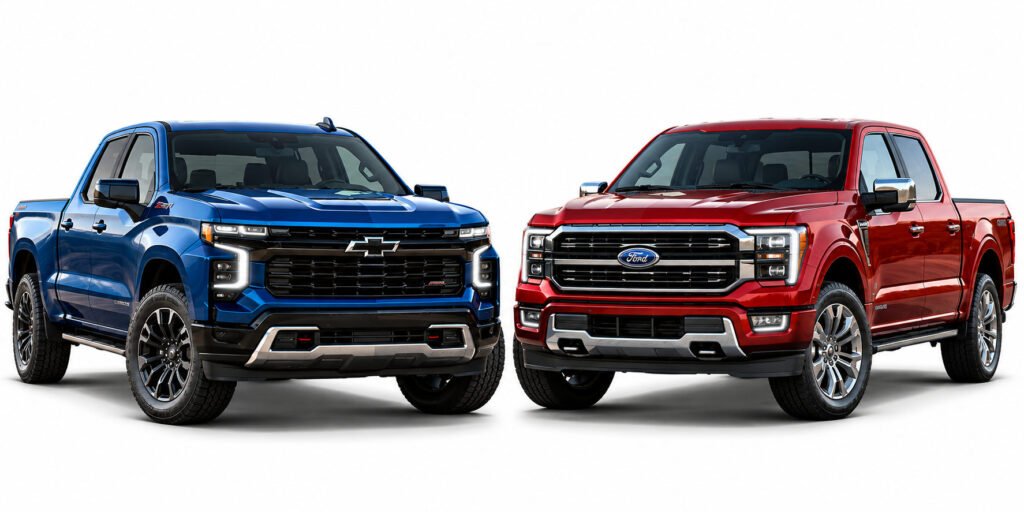
The Silverado can tow up to 13,700 pounds, compared with the Ford’s 13,500-pound maximum. However, choosing the better truck requires looking beyond those headline numbers. Engine configuration, payload, fuel economy, cabin technology, and actual purchase price may matter considerably more.
Chevrolet Redesigns, Ford Refines: What’s New for 2027?
The 2027 Silverado 1500 represents a genuine generational change. Chevrolet introduces sharper exterior styling, redesigned lighting, an upgraded interior, and a new seven-trim structure. The traditional LT designation is replaced by a trim simply called Silverado.
More importantly, Chevrolet replaces its previous V8 offerings with new 5.7-liter and 6.6-liter engines. The smaller TurboMax engine also receives improvements and a 10-speed automatic transmission.
Ford takes a more conservative approach.
The 2027 F-150 receives redesigned grilles and wheels on selected trims, while a new 3.0-liter EcoBoost V6 replaces the previous 2.7-liter engine. Ford also introduces BlueCruise with Towing, more affordable versions of its Tremor and Raptor off-road trucks, and a Carhartt edition.
Chevrolet offers the more substantial transformation. Ford focuses on refining an established design.
2027 Silverado vs F-150 Price: Which Costs Less?
The entry-level 2027 Ford F-150 XL starts at $40,585, including destination charges. Chevrolet’s Silverado Work Truck starts at $41,395, also including destination.
That gives Ford an $810 starting-price advantage.
Chevrolet has published pricing across its seven-trim lineup:
| 2027 Silverado Trim | Starting Price |
|---|---|
| Work Truck | $41,395 |
| Custom | $46,395 |
| Silverado | $50,695 |
| Custom Trail Boss | $57,195 |
| Trail Boss | $63,995 |
| High Country | $74,495 |
| ZR2 | $79,995 |
All prices include the $2,795 destination charge.
Ford offers XL, STX, XLT, Lariat, Tremor, King Ranch, Platinum, and Raptor grades. Its new Carhartt edition starts at $65,455 including destination.
However, starting prices do not tell the complete story. Crew-cab layouts, four-wheel drive, optional engines, and towing packages can considerably increase the final price.
A properly equipped midrange truck may provide better value than a luxurious model with capability its owner rarely uses.
Engine Comparison: Chevy V8 Power vs Ford EcoBoost Torque
Chevrolet’s most significant mechanical advancement is its new naturally aspirated V8 family.
The 5.7-liter V8 produces 402 horsepower and 428 lb-ft of torque. Above it sits a 6.6-liter V8 generating 481 horsepower and 501 lb-ft.
For buyers who prefer traditional V8 performance without turbocharging, these engines are particularly appealing.
Chevrolet also offers a 2.7-liter TurboMax with 350 horsepower and 455 lb-ft, plus a 3.0-liter Duramax diesel producing 305 horsepower and 495 lb-ft.
Ford provides a wider variety of gasoline and electrified powertrains.
Its new 3.0-liter EcoBoost produces 325 horsepower and 400 lb-ft, while the 5.0-liter V8 develops 400 horsepower and 410 lb-ft.
The 3.5-liter EcoBoost offers 400 horsepower and 500 lb-ft. Meanwhile, the PowerBoost hybrid combines gasoline and electric assistance to produce 430 horsepower and 570 lb-ft.
Specialized Raptor models reach 450 horsepower with the high-output V6 or 720 horsepower with the supercharged 5.2-liter V8.
The distinction is straightforward: Chevrolet offers a powerful new naturally aspirated V8, while Ford supplies more powertrain diversity and considerably higher hybrid torque.
Towing and Payload: The Numbers That Actually Matter
The 2027 Silverado achieves a maximum towing capacity of 13,700 pounds using its 5.7-liter V8, a Double Cab, standard bed, two-wheel drive, and Max Trailering Package.
Ford’s maximum is 13,500 pounds with the 3.5-liter EcoBoost, a four-wheel-drive SuperCrew, 6.5-foot bed, and the appropriate towing equipment.
Chevrolet therefore leads maximum towing by 200 pounds, although these are different truck configurations.
One unexpected detail deserves attention: Chevrolet’s more powerful 6.6-liter V8 has a published maximum towing rating of just 9,700 pounds.
Its maximum rating applies to selected four-wheel-drive configurations, including the off-road-focused ZR2. More horsepower does not automatically produce a higher towing rating.
Payload tells another story.
The Silverado’s maximum payload is 2,340 pounds with the TurboMax engine. Ford reaches 2,440 pounds with the 3.5-liter EcoBoost, giving the F-150 a 100-pound advantage.
That matters when carrying heavy tools, construction materials, passengers, and trailer tongue weight.
For example, a trailer placing 900 pounds on the hitch leaves considerably less payload available for passengers and cargo.
Buyer advice: Check the exact truck’s door-jamb payload label, towing guide, axle ratings, and trailer specifications before purchasing. The maximum advertised capability may not apply to your chosen configuration.
Ford Hybrid vs Silverado Diesel: Two Different Efficiency Strategies
Ford’s strongest advantage in powertrain variety is the PowerBoost hybrid.
Unlike a plug-in hybrid, it does not require external charging. Its gasoline engine and electric motor work together, while regenerative braking helps recover energy.
An available 7.2-kW Pro Power Onboard system also allows the truck to supply electricity for tools, camping equipment, or other compatible devices.
Chevrolet takes another approach with its 3.0-liter Duramax turbo-diesel.
The engine delivers 495 lb-ft of torque and supports a maximum towing rating of 12,000 pounds.
Chevrolet estimates more than 900 miles of highway driving range with the available approximately 34-gallon tank and appropriate diesel configuration.
That figure is a manufacturer projection rather than an independently confirmed EPA range rating.
Comparable final 2027 EPA fuel-economy figures are needed before declaring either truck the efficiency winner. Diesel fuel prices, maintenance, annual mileage, and towing frequency will influence actual ownership costs.
Interior, Technology and Everyday Practicality
The Silverado introduces one of the most noticeable interior improvements in this comparison.
Every 2027 model receives a 16.3-inch central display and 12.2-inch digital driver information display.
Apple CarPlay, Android Auto, and Google built-in services are integrated into the new interface. High Country and ZR2 models also receive an 11.5-inch passenger display, head-up display, and rear camera mirror.
Other available equipment includes dual wireless phone charging, an adjustable center console, and multiple camera views for parking and trailering.
Ford counters with its familiar SYNC 4 interface, smartphone connectivity, practical storage solutions, and available Pro Access Tailgate.
The F-150’s available onboard electrical power is particularly useful for contractors or campers who otherwise rely on portable generators.
Both trucks offer cab and bed configurations suited to different needs. Crew-cab buyers should examine rear-seat space, child-seat installation, bed length, and overall vehicle dimensions before choosing.
Chevrolet has the more extensively redesigned dashboard. Ford emphasizes established usability and practical work-focused features.
Super Cruise vs BlueCruise: Which Helps More While Towing?
Both manufacturers now offer hands-free driver assistance while towing, but neither system makes the truck autonomous.
Chevrolet’s Super Cruise supports trailering on compatible roads and, in appropriate configurations, towing up to 13,600 pounds.
Ford introduces BlueCruise with Towing for eligible 2027 F-150 models, operating on designated Blue Zones with restrictions based on trailer characteristics.
Chevrolet advertises approximately 630,000 miles of compatible North American roads, while Ford identifies more than 130,000 miles for its towing-capable BlueCruise system.
Neither figure guarantees coverage on a particular journey.
Both systems require an attentive driver and an active subscription or trial. Trailer limitations and feature availability should be checked before purchase.
Off-Road Capability: Trail Boss, Tremor, ZR2 and Raptor
Chevrolet’s Trail Boss combines a factory suspension lift with aggressive tires and off-road-oriented equipment.
The ZR2 moves further into serious trail capability, offering 35-inch mud-terrain tires, front and rear electronic locking differentials, Multimatic DSSV dampers, and additional underbody protection.
Ford’s Tremor is aimed at drivers who want meaningful off-road equipment without purchasing a Raptor.
The Raptor family prioritizes higher-speed off-road performance, with specialized suspension hardware and powerful engines.
For most recreational trail driving, Trail Boss and Tremor represent more practical starting points. The ZR2 and Raptor appeal to buyers who will actually use their specialized capabilities.
Reliability, Safety and Ownership Costs
Long-term reliability remains an important unknown, particularly for Chevrolet’s new-generation V8 engines.
There is insufficient ownership history to make definitive claims about their durability or repair frequency.
Ford’s existing engine families have longer service histories, although the new 3.0-liter EcoBoost configuration must also establish its own record.
Both manufacturers provide extensive driver-assistance equipment, but availability differs by trim and package.
Buyers should verify applicable NHTSA and IIHS ratings rather than relying on crash-test results from older or differently configured models.
Insurance, tire replacement, towing-related maintenance, subscription fees, and depreciation can substantially influence ownership costs.
Which 2027 Pickup Should You Buy?
The better choice depends on how the truck will actually be used.
For regular heavy towing: Compare a properly equipped Silverado 5.7-liter V8 against the F-150 3.5-liter EcoBoost. Both offer exceptional published capacity.
For contractors: Ford’s higher maximum payload and available onboard power provide practical advantages.
For long-distance driving: Chevrolet’s Duramax deserves consideration, especially when extended highway range matters.
For everyday driving: Ford’s PowerBoost hybrid offers an appealing combination of torque and electrified operation.
For traditional V8 buyers: Chevrolet’s new 5.7-liter engine may be the more interesting option.
For off-road enthusiasts: Evaluate Trail Boss against Tremor or ZR2 against Raptor according to the terrain and driving style.
The strongest overall value will likely come from a carefully equipped midrange truck rather than either manufacturer’s most expensive model.
Frequently Asked Questions
When will the 2027 Silverado 1500 be available?
Chevrolet expects U.S. sales to begin toward the end of 2026. Availability may vary by trim and configuration.
Does the 2027 Silverado offer a hybrid engine?
No conventional hybrid is listed among its four announced engines. Buyers can choose gasoline V8, TurboMax, or Duramax diesel power.
Does the 2027 F-150 offer a diesel engine?
No. Ford’s published 2027 F-150 lineup includes gasoline engines and the PowerBoost gasoline-electric hybrid.
Which truck has the highest towing capacity?
The Silverado leads with 13,700 pounds, compared with 13,500 pounds for the F-150, when each is configured for its maximum rating.
Can the 2027 F-150 hybrid run tools?
Yes. Properly equipped PowerBoost models offer Pro Power Onboard, including an available 7.2-kW system for compatible electrical equipment.
TillDrive Editorial Verdict
The 2027 Silverado 1500 makes the stronger case for buyers seeking a genuinely new truck, modern cabin technology, naturally aspirated V8 power, or diesel availability.
Ford’s F-150 remains exceptionally competitive through its PowerBoost hybrid, onboard power capabilities, engine variety, and slightly higher maximum payload.
Neither truck wins every category.
For heavy towing, the exact configuration matters more than brand loyalty. For daily practicality, the F-150 hybrid deserves particular attention. For buyers who want the newest full-size Chevrolet design and V8 engineering, the Silverado is a compelling alternative.
2027 Chevrolet Silverado 1500 vs Ford F-150 Quick Specs
| Specification | Silverado 1500 | Ford F-150 |
|---|---|---|
| Manufacturer | Chevrolet | Ford |
| Model year | 2027 | 2027 |
| Vehicle type | Full-size pickup | Full-size pickup |
| Starting U.S. price | $41,395 | $40,585 |
| Base engine | 2.7L TurboMax | 3.0L EcoBoost V6 |
| Base horsepower | 350 hp | 325 hp |
| Base torque | 455 lb-ft | 400 lb-ft |
| Most powerful engine | 6.6L V8 | 5.2L supercharged V8, Raptor R |
| Maximum horsepower | 481 hp | 720 hp |
| Maximum engine torque | 501 lb-ft | 640 lb-ft |
| Transmission | 10-speed automatic | 10-speed automatic |
| Drivetrain | 2WD / 4WD | 2WD / 4WD |
| Maximum towing | 13,700 lb | 13,500 lb |
| Maximum payload | 2,340 lb | 2,440 lb |
| Diesel engine | 3.0L Duramax | Not offered |
| Hybrid option | Not announced | 3.5L PowerBoost |
| Maximum available fuel tank | Approx. 34 gal | 36 gal |
| Hands-free towing assistance | Super Cruise | BlueCruise |
| Maximum central display | 16.3 inches | 12 inches |
| 0–60 mph | No verified 2027 comparison | Configuration-dependent |
| Top speed | Not established for comparison | Configuration-dependent |
| Fuel economy | Final comparable EPA figures pending | Final comparable EPA figures pending |
| Seating | Cab-dependent | Cab-dependent |
Specifications are manufacturer-published figures as of October 2026. Maximum capabilities apply to different configurations and may not be available simultaneously. Starting prices include destination charges but exclude taxes, dealer fees, and optional equipment.