Introduction
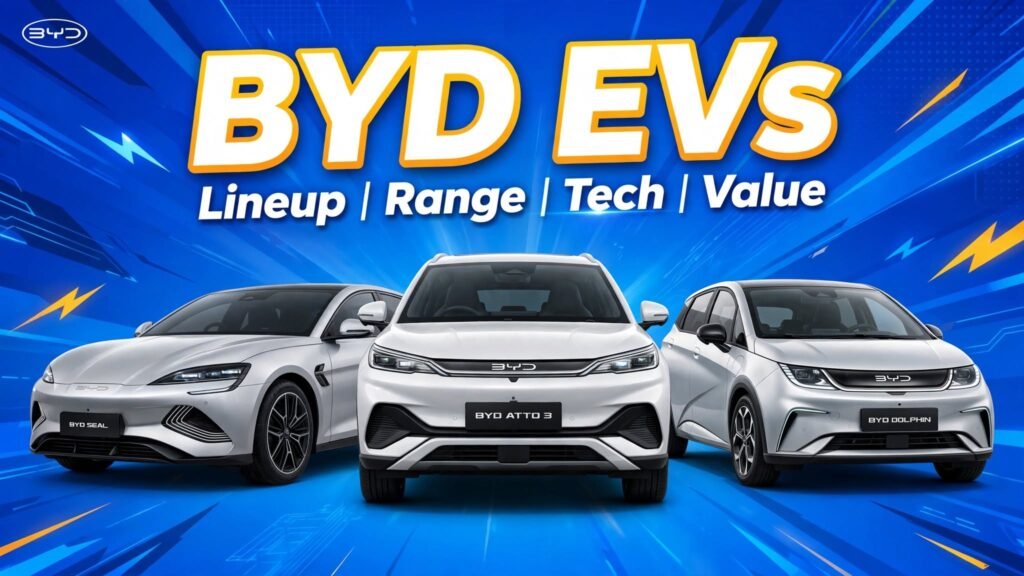
BYD Electric Vehicles have moved from being a relatively unfamiliar name in many international markets to becoming one of the most important EV portfolios outside the traditional European, Japanese and American manufacturers. The key point is that BYD is not represented by a single electric car. Its lineup spans compact city cars, hatchbacks, crossovers, executive sedans, performance SUVs and larger seven-seat models, with availability varying considerably by country.
The engineering strategy is equally broad. BYD develops its own Blade Battery technology, dedicated EV architectures, electric motors and integrated powertrain systems rather than simply adapting conventional combustion platforms. Its European range, for example, includes the Dolphin Surf, Dolphin, Atto 2, Atto 3, Seal, Seal U, Sealion 7, Tang and Han.
That breadth makes BYD Electric Vehicles particularly interesting for buyers who want to compare several EV formats within one manufacturer. It also creates an important caveat: specifications, model names, equipment and prices can change by market. The analysis below therefore treats BYD Electric Vehicles as a global EV family, using current 2026-era European information as the primary reference point and identifying market-specific differences where relevant.
What Are BYD Electric Vehicles?
BYD Electric Vehicles are battery-electric passenger cars produced by BYD Auto, the automotive division of Chinese technology and manufacturing company BYD.
The company has built its EV strategy around vertical integration. Instead of relying entirely on outside suppliers, BYD develops major components including batteries, electric motors, electronic control systems and powertrain technology. Its e-Platform 3.0 was designed specifically for pure-electric vehicles and supports front-wheel drive, rear-wheel drive and all-wheel drive configurations, while also accommodating different electrical architectures and motor layouts.
BYD’s current pure-electric family includes models positioned at very different points in the market:
- Dolphin Surf: compact urban EV
- Dolphin: practical electric hatchback
- Atto 2: compact electric SUV
- Atto 3 and Atto 3 EVO: compact crossover SUVs
- Seal: electric executive sedan
- Seal U: family-oriented electric SUV
- Sealion 7: larger performance-oriented electric SUV
- Tang: seven-seat electric SUV
- Han: larger electric executive sedan
Not every model is sold in every country. BYD’s European model list demonstrates how quickly the range has expanded, with newer products such as the Atto 3 EVO joining established models.
BYD Electric Vehicle Lineup Explained
BYD Dolphin Surf
The Dolphin Surf occupies the city-car end of BYD’s electric range. It is designed around compact dimensions, maneuverability and relatively accessible EV ownership.
BYD’s UK information lists a WLTP combined range of up to 200 miles and a 30% to 80% fast-charging time of 22 minutes for the Dolphin Surf.
Its appeal is straightforward: buyers who spend most of their time in urban areas do not necessarily need a large battery, large SUV or high-output dual-motor system.
BYD Dolphin
The larger Dolphin is an electric hatchback aimed at buyers who need more versatility than a small city car but do not want an SUV.
BYD lists up to 427 km of WLTP combined range and up to 150 kW of power for the European Dolphin. Its 345-liter boot also makes it more practical than its compact exterior might suggest.
The Dolphin is arguably one of the most rational models in the range because its relatively compact format matches the strengths of electric propulsion particularly well: quiet urban operation, instant torque and straightforward one-pedal-style regenerative driving characteristics.
BYD Atto 2
The Atto 2 is positioned as a compact electric SUV. It sits below the Atto 3 and targets buyers who want the higher seating position and practicality of a crossover without moving into a larger vehicle.
BYD’s European range identifies the Atto 2 specifically as an electric compact SUV.
This segment is strategically important because compact SUVs remain one of the largest areas of consumer demand in many markets.
BYD Atto 3 and Atto 3 EVO
The Atto 3 has become one of BYD’s best-known international electric models. It uses the company’s e-Platform 3.0 and Blade Battery architecture.
The current European specification lists up to 420 km of range and 0 to 100 km/h acceleration in 7.3 seconds. BYD also quotes a 150 kW motor and DC charging capability of up to 88 kW on the referenced specification.
One of the Atto 3’s strengths is packaging. The dedicated EV platform permits a flat rear floor, contributing to usable rear passenger space. The vehicle also uses an integrated electric powertrain that combines eight major components into one system, helping reduce packaging complexity and improve space and efficiency.
The newer Atto 3 EVO represents BYD’s attempt to push the compact SUV further in terms of performance, efficiency and range. BYD’s European site lists the Atto 3 EVO with a claimed 510 km range, although exact specifications and equipment depend on market.
BYD Seal
The Seal is the more performance-focused electric sedan in the mainstream BYD lineup.
European specifications list up to 570 km of WLTP range and 0 to 62 mph in as little as 3.8 seconds for the applicable version.
Its significance is greater than its sales position alone might suggest. The Seal shows BYD competing directly in a category historically dominated by established premium and mainstream manufacturers. Its low-slung shape, strong acceleration and dedicated EV architecture give it a different character from the company’s crossover-heavy models.
BYD Seal U
The Seal U is designed primarily as a family SUV. It emphasizes cabin space and comfort rather than the sharper performance positioning of the Sealion 7.
BYD lists up to 500 km of WLTP range and 0 to 100 km/h in 5.9 seconds for the applicable electric version, along with a five-star Euro NCAP rating.
For buyers choosing between BYD Electric Vehicles, the Seal U makes more sense when passenger and luggage practicality matter more than outright acceleration.
BYD Sealion 7
The Sealion 7 occupies a more premium and performance-oriented SUV position.
Depending on specification, BYD’s European data lists rear-wheel-drive and all-wheel-drive configurations, outputs reaching 390 kW, 0 to 100 km/h in 4.5 seconds and WLTP ranges reaching 502 km in the original European launch specifications. Battery capacities range from 82.5 kWh to 91.3 kWh depending on version.
The Sealion 7 is particularly notable because it combines a relatively large battery with strong performance while retaining practical SUV packaging. Higher versions also support substantially faster DC charging than some earlier BYD models.
BYD Tang
The Tang is the large family option in BYD’s pure-electric SUV portfolio.
European specifications list seven seats, all-wheel drive, up to 530 km of WLTP range and 0 to 100 km/h in 4.9 seconds. Its 108.8 kWh battery and 170 kW DC charging capability place it well above BYD’s smaller models in both size and battery capacity.
The Tang is therefore less about maximum efficiency per dollar and more about providing a genuinely large electric vehicle for families that need additional seating.
BYD Han
The Han is an executive electric sedan with a stronger emphasis on performance, refinement and long-distance capability.
BYD’s European information lists up to 521 km of WLTP range, all-wheel drive and 0 to 100 km/h acceleration in 3.9 seconds.
It occupies a niche similar to larger electric sedans from established premium manufacturers, although its positioning and equipment vary substantially by market.
Blade Battery Technology
Battery technology is one of the defining features of BYD Electric Vehicles.
The company’s Blade Battery uses lithium iron phosphate, commonly abbreviated LFP. BYD says the battery architecture was developed with a strong focus on safety, durability and efficient packaging. Its published technology information highlights the battery’s nail-penetration testing and the absence of nickel and cobalt in the chemistry used for the Blade Battery.
The importance of LFP extends beyond headline safety claims. LFP batteries generally offer strong cycle durability and avoid nickel and cobalt, although energy density, charging behavior and cold-weather performance still vary according to battery generation, vehicle design and operating conditions.
BYD also uses structural battery integration in some vehicles. Its Cell-to-Body approach makes the battery pack part of the vehicle’s structural architecture, helping improve packaging and body rigidity. BYD reports torsional stiffness of up to 40,500 Nm per degree for vehicles using the relevant technology.
For consumers, the bigger takeaway is that BYD treats the battery as a core vehicle component rather than simply a replaceable energy source.
EV Range and Efficiency
There is no single range figure for BYD Electric Vehicles because the lineup covers everything from small hatchbacks to large seven-seat SUVs.
Current European examples illustrate the spread:
| BYD model | Vehicle type | Published maximum range |
|---|---|---|
| Dolphin Surf | City EV | Up to 200 miles WLTP |
| Dolphin | Electric hatchback | Up to 427 km WLTP |
| Atto 2 | Compact SUV | Market-dependent |
| Atto 3 | Compact SUV | Up to 420 km WLTP |
| Atto 3 EVO | Electric SUV | Up to 510 km |
| Seal | Electric sedan | Up to 570 km WLTP |
| Seal U | Family SUV | Up to 500 km WLTP |
| Sealion 7 | Performance SUV | Up to 502 km WLTP |
| Tang | Seven-seat SUV | Up to 530 km WLTP |
| Han | Executive sedan | Up to 521 km WLTP |
These numbers should not be compared without considering vehicle size, battery capacity, wheel choice, drivetrain and testing cycle. WLTP is also a laboratory-based standardized test rather than a guarantee of real-world driving range.
Weather, speed, heating or air conditioning, payload and driving style can all reduce actual range.
Charging BYD Electric Vehicles
Charging capability varies significantly across the BYD range.
The Atto 3, for example, is listed with DC charging capability of up to 88 kW in the referenced specification, while the Sealion 7 can support up to 150 kW in some versions and up to 230 kW in its highest specification.
This distinction matters because a large battery does not automatically mean a faster road-trip experience. Charging power, the vehicle’s charging curve, battery temperature and the availability of suitable charging infrastructure all influence how quickly an EV can add useful range.
BYD also equips its vehicles with heat-pump technology in relevant markets. The system can recover and reuse heat from the powertrain and other components, helping reduce energy losses associated with cabin heating and cooling.
Interior, Comfort and Technology
BYD interiors tend to prioritize large displays, digital controls and high equipment levels.
The Atto 3, for example, features a rotatable 15.6-inch touchscreen in the cited specification, with Apple CarPlay and Android Auto availability depending on market. OTA updates are also supported.
The company’s approach can be appealing to buyers who associate value with visible technology. However, screen size alone does not determine usability. The more important question is how easily drivers can access climate controls, navigation, vehicle settings and smartphone functions while driving.
BYD also offers advanced driver-assistance systems across its range, including features such as lane keeping, blind-spot monitoring and rear cross-traffic assistance on applicable models. Equipment levels vary by vehicle and market.
Safety
Safety is one of BYD’s stronger selling points in markets where its vehicles have been independently tested.
BYD reports five-star Euro NCAP results for several European-market vehicles, including the Seal, Dolphin, Atto 3, Seal U and Sealion 7. The company also lists five-star results from ANCAP for several Australian-market models.
Those results should be interpreted on a model-specific and test-date basis. A five-star rating for one BYD model should not automatically be transferred to every vehicle in the range.
The underlying battery structure is also relevant. BYD’s Blade Battery and cell-to-body technology are intended to contribute to crash protection and structural strength, but independent crash testing remains more meaningful to consumers than manufacturer engineering claims alone.
Pricing and Availability
Pricing is one area where it is impossible to provide a single global answer for BYD Electric Vehicles.
Taxes, import duties, local assembly, incentives, trim availability, exchange rates and distributor strategy can all change the final price.
Pakistan provides a useful example of this variation. Current 2026 listings show the Atto 2 Premium at approximately PKR 7.29 million, the Atto 3 Advance at PKR 8.99 million, the Seal Dynamic at PKR 14.79 million, the Seal Premium at PKR 16.99 million and the Sealion 7 Advanced at PKR 15.49 million. These are listed ex-factory prices and should not be treated as universal BYD pricing.
The broader lesson for buyers is simple: compare the exact local trim and its included equipment rather than using an overseas price as a benchmark.
Reliability and Ownership
BYD’s relatively young position in many international passenger-car markets means its long-term reliability record is not as mature as that of manufacturers with decades of established EV fleets.
That does not mean BYD Electric Vehicles are inherently unreliable. It means consumers should distinguish between engineering design, warranty coverage and statistically established long-term reliability.
The company’s battery-focused strategy may provide some advantages. LFP chemistry is known for durability, while BYD’s high level of component integration can reduce the number of separate major powertrain components compared with conventional vehicles.
Ownership also depends heavily on local support. Dealer quality, parts availability, software support, charging infrastructure and battery warranty terms can matter as much as the vehicle itself.
For buyers considering a BYD EV, the most important ownership questions are therefore local rather than global: Who services the vehicle? How quickly are parts supplied? What does the battery warranty cover? Is software support established? And how strong is the local charging network?
BYD Electric Vehicles: Key Specification Snapshot
| Specification | BYD Electric Vehicles |
|---|---|
| Manufacturer | BYD Auto |
| Vehicle types | Hatchbacks, sedans, crossovers and SUVs |
| Powertrain | Battery-electric, with market-dependent hybrid models outside this EV-focused range |
| Battery technology | Blade Battery, predominantly LFP chemistry |
| EV architecture | e-Platform 3.0 and newer architectures on applicable models |
| Drivetrains | Front-wheel drive, rear-wheel drive and all-wheel drive depending on model |
| Maximum published range | Up to roughly 570 km WLTP in the current European lineup |
| Maximum published output | Varies widely by model and trim |
| Seating | Typically 5, with Tang offering 7 seats |
| Charging | AC and DC charging, with capability varying substantially by model |
| Transmission | Single-speed electric reduction drive |
| Safety | Five-star Euro NCAP ratings on several European-market models |
| Market availability | Varies by country and model year |
The table represents the BYD EV family rather than one specific vehicle, so individual specifications must always be checked against the exact local model and trim.
Pros and Cons
Pros
- Strong battery expertise and extensive vertical integration
- Broad EV lineup covering several vehicle segments
- Blade Battery technology based on LFP chemistry
- Competitive performance in several models
- Strong equipment levels in many markets
- Dedicated EV architecture on key models
- Several independently tested five-star safety models
- Useful range of body styles, from compact hatchbacks to seven-seat SUVs
- Increasingly competitive fast-charging technology
- Strong technology content for the money in many markets
Cons
- Model availability varies substantially between countries
- Long-term reliability data is less mature than for established manufacturers
- Local dealer and parts support can be decisive
- Some older BYD models have more modest DC charging performance than newer rivals
- Real-world range can fall substantially below laboratory figures in demanding conditions
- High equipment levels do not automatically mean every feature is equally intuitive
- Resale values remain harder to predict in some markets
Competitor Analysis
BYD vs Tesla
Tesla remains a major benchmark for EV efficiency, charging infrastructure and software integration. BYD counters with a much broader traditional vehicle lineup and significant battery manufacturing expertise.
The Seal is the most natural BYD alternative to Tesla’s Model 3 in terms of concept, while BYD’s SUV portfolio gives it more variety than Tesla offers in several markets.
BYD vs Hyundai and Kia
Hyundai and Kia have strong reputations for EV packaging, charging technology and mature global dealer networks.
BYD’s advantage is its battery integration and aggressive product expansion. Hyundai and Kia generally have the stronger long-established international service footprint, while BYD can offer compelling equipment and pricing where its distribution network is competitive.
BYD vs Volkswagen
Volkswagen’s electric lineup benefits from a large established dealer network and decades of European-market presence.
BYD’s advantage is that many of its EVs were designed around electrification from the outset, rather than emerging from a manufacturer transitioning a broad combustion portfolio toward EVs.
BYD vs Toyota
Toyota has enormous global manufacturing scale and a long-standing reputation for reliability, but its pure-electric passenger-car portfolio has historically been narrower than BYD’s.
For a buyer specifically seeking a battery-electric vehicle today, BYD generally offers more EV body styles and powertrain choices. Toyota’s strength remains its established ownership ecosystem and broader hybrid strategy.
BYD vs Chinese EV Rivals
BYD competes directly with brands such as MG, Geely, Chery, NIO, XPeng and other Chinese manufacturers in various markets.
The key difference is scale and vertical integration. BYD’s battery manufacturing, electronics expertise and broad product portfolio give it an unusually deep position across the EV supply chain.
Who Should Buy BYD Electric Vehicles?
BYD Electric Vehicles make the most sense for buyers who want a dedicated EV with substantial technology, modern battery architecture and a choice of body styles.
The range is particularly attractive to:
- Urban drivers who want a compact electric car
- Families looking for an electric crossover
- Buyers wanting strong standard equipment
- Drivers interested in EV performance without automatically moving into a luxury brand
- Consumers who value LFP battery technology
- Buyers in markets where BYD has established dealers and service support
- Families needing a larger electric SUV such as the Tang
The best BYD is ultimately determined by usage. A Dolphin can be a more sensible choice for city driving than a large SUV, while a Sealion 7 or Tang makes more sense for buyers who prioritize space and performance.
Who Should Consider Alternatives?
BYD may not be the best choice for every buyer.
Consider alternatives if your priorities include:
- A very mature long-term reliability record
- The largest possible public fast-charging network
- A deeply established local dealer network
- Highly predictable resale values
- A specific luxury-brand ownership experience
- A vehicle with proven long-term availability of parts in your region
In emerging BYD markets, local after-sales support should be evaluated before the purchase. A technically impressive EV is less attractive if servicing, software updates or replacement parts are difficult to obtain.
FAQ
Are BYD Electric Vehicles fully electric?
Yes. BYD has a substantial pure-electric lineup including the Dolphin, Atto 2, Atto 3, Seal, Seal U, Sealion 7, Tang and Han in markets such as Europe. BYD also sells plug-in hybrid vehicles, so buyers should distinguish between its pure-electric and DM-i hybrid models.
What battery do BYD Electric Vehicles use?
Many BYD electric vehicles use the company’s Blade Battery, based on lithium iron phosphate chemistry. BYD emphasizes its safety, durability and packaging characteristics.
How far can a BYD electric car travel on one charge?
Range depends on the model, battery, drivetrain and test cycle. Current European examples range from around 200 miles WLTP for the Dolphin Surf to up to 570 km WLTP for the Seal.
Are BYD Electric Vehicles reliable?
It is too early to give the entire BYD EV range a definitive long-term reliability rating. The company has extensive experience producing batteries and electric vehicles, but long-term ownership data varies by model and market.
Are BYD cars safe?
Several BYD models have achieved five-star independent safety ratings in major markets. Euro NCAP has awarded five stars to multiple European-market BYD models, although safety ratings should always be checked for the exact model and test year.
How long does it take to charge a BYD EV?
Charging time varies considerably. The Atto 3, for example, is listed with DC charging up to 88 kW, while higher-specification Sealion 7 versions can accept considerably more power.
Which BYD electric vehicle is best for families?
The answer depends on family size. The Atto 3 and Seal U are sensible five-seat choices, while the Tang is the more appropriate option for buyers who genuinely need seven seats.
Are BYD Electric Vehicles worth buying?
They can be, particularly where pricing, dealer support and charging infrastructure are competitive. Their combination of battery technology, equipment, range and model variety makes BYD one of the most significant EV manufacturers to consider. The exact value depends heavily on the local model, trim and ownership support.
Final Verdict
BYD Electric Vehicles deserve to be evaluated as a complete automotive strategy rather than as one Chinese alternative to established EV brands. The company has built a remarkably broad electric portfolio and controls important parts of the technology behind it, particularly battery production and electric powertrain development.
The strongest argument for BYD is the combination of variety and engineering depth. A buyer can move from the compact Dolphin Surf to the practical Atto 3, the performance-oriented Seal, the Sealion 7 or the seven-seat Tang without leaving the same manufacturer.
The main qualification is market maturity. BYD’s ownership experience depends heavily on the strength of the local dealer, charging and parts network, while long-term reliability and resale data remain less established in some markets.
For buyers in a market with strong BYD support, however, the brand’s electric vehicles are no longer niche alternatives. They are serious competitors across multiple segments, and their battery technology, equipment levels and rapidly expanding model range make them one of the most important EV portfolios in the global market. BYD reported more than 16.5 million cumulative new-energy-vehicle sales by the end of May 2026, illustrating the scale behind the company’s electrification strategy.